
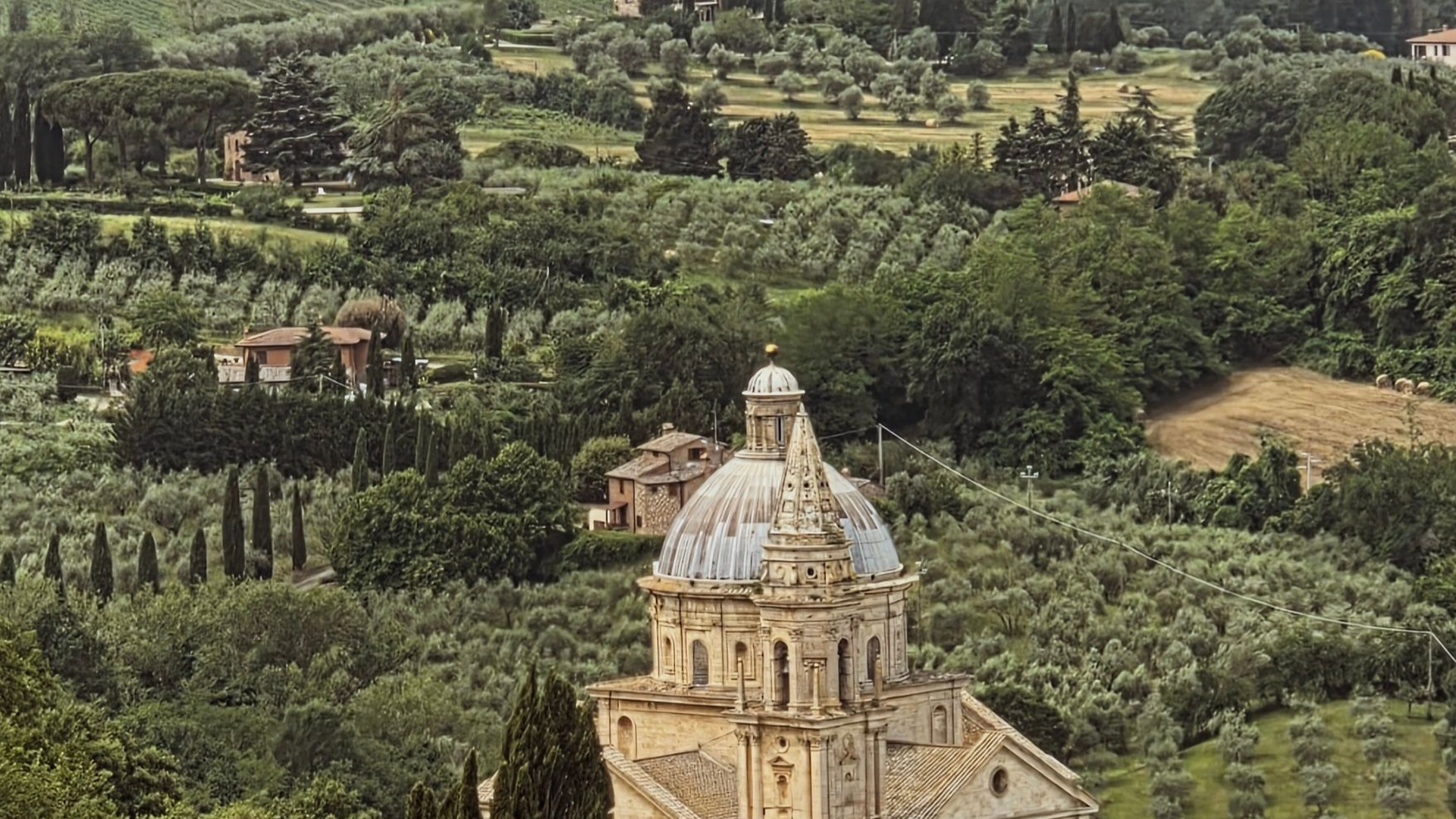
Every wine-focused corner of Tuscany seems to get slotted into a hierarchy sooner or later, and Montepulciano has spent decades sitting just below Montalcino in that pecking order — „the other big red town,“ the one people visit second, after Brunello. That reputation undersells it considerably. Montepulciano produces Vino Nobile, one of only four Tuscan wines to hold the DOCG classification, and it does so from one of the most striking hilltop towns in the entire region, with a Renaissance streetscape that arguably outclasses Montalcino’s more modest historic center.
Sitting roughly 1.5 hours southeast of Florence and about 45 minutes from Montalcino, Montepulciano makes an excellent second stop on any serious Tuscan wine trip, and a genuinely rewarding destination on its own if a full-blown Brunello itinerary isn’t in the cards.
A Town Built on a Ridge, Not Just a Hill
Where most Tuscan wine towns sit atop a rounded hill, Montepulciano stretches along a long, narrow limestone ridge at just over 600 meters, giving it one of the more dramatic silhouettes in the region when approached from the valley below. The main street, Corso, climbs almost the entire length of the old town from the Porta al Prato gate up to the Piazza Grande at the summit, lined the whole way with Renaissance palazzi, wine shops carved into medieval cellars, and enough gelaterias and enotecas to make the climb feel entirely reasonable.
Piazza Grande itself, at the top, is worth the walk on its own merits: a genuinely handsome Renaissance square anchored by the town’s Duomo and the crenellated Palazzo Comunale, whose tower can be climbed for a sweeping view over the Val di Chiana on one side and the Val d’Orcia on the other — a rare vantage point that captures both of Tuscany’s most celebrated valleys from a single spot.
Vino Nobile: Sangiovese’s More Sociable Sibling
Vino Nobile di Montepulciano is made primarily from Sangiovese, locally often called Prugnolo Gentile, a clone specific to this area. The DOCG rules require a minimum of 70% Sangiovese, with the remainder typically filled by complementary local or international varieties, giving producers slightly more flexibility than the strict 100% Sangiovese rule governing Brunello just down the road.
That flexibility shows up in the glass. Vino Nobile tends to be rounder and more immediately generous than Brunello, with softer tannins, riper dark fruit, and a shorter mandatory aging period — a minimum of two years, with at least one year in oak, compared to Brunello’s five. The result is a wine that’s genuinely ready to enjoy sooner, without asking the drinker to wait out a decade in the cellar first. For a long time, this softer profile earned Vino Nobile an unfair reputation as „Brunello’s little brother,“ a wine to settle for rather than seek out — a characterization that the region’s better producers have spent the last twenty years actively dismantling.
The Tiers, and What Actually Changes Between Them
Rosso di Montepulciano
The zone’s everyday red, released after just a few months of aging. Fresh, easy-drinking, and a genuinely good way to taste a producer’s fruit before committing to the DOCG bottling.
Vino Nobile di Montepulciano
The standard DOCG wine, aged a minimum of two years. Balanced, food-friendly, and the bottle most visitors leave town with.
Vino Nobile di Montepulciano Riserva
Aged a minimum of three years, made from a producer’s best fruit in strong vintages. Noticeably deeper and more structured, closer in weight to a Chianti Classico Gran Selezione than to entry-level Vino Nobile.
A flight moving through all three, widely available at enotecas along the Corso, makes the aging progression obvious within a few sips — useful groundwork before heading out to taste at the estates themselves.
Cellars Beneath the Streets
One of Montepulciano’s genuine oddities, and one of its best free attractions, is that several of the town’s historic wine producers maintain their cellars directly beneath the historic center rather than out in the countryside. A handful of the larger, longer-established houses offer walk-in tastings and cellar visits right along the Corso, carved into Etruscan and medieval tunnels that run beneath the Renaissance streets above. It’s a genuinely unusual way to taste wine — descending several levels underground into cool, centuries-old stone cellars stacked with barrels, then climbing back up into bright Tuscan sunlight a few minutes later.
That said, the more serious, more critically regarded producers tend to be based out in the surrounding countryside, on the same rolling hills that separate Montepulciano from Montalcino and Pienza. These estates generally require advance booking, much like their counterparts elsewhere in Tuscany, and reward the extra planning with a more in-depth look at how the wine is actually grown, not just aged.
Montepulciano at a Glance
| Area | Character | Best For |
|---|---|---|
| Piazza Grande & the Corso | Renaissance streetscape, underground cellars | Walk-in tastings, a first orientation |
| Countryside estates | Rolling hills toward Pienza and Montalcino | Serious tasting, appointment-only visits |
| Val di Chiana side | Broader, flatter valley views | Sunset views from the Palazzo Comunale tower |
| Val d’Orcia side | Classic Tuscan hills, cypress-lined roads | Combining with a Pienza or Montalcino day |
Food: Pici, Pork, and a Local Cheese Worth Seeking Out
Montepulciano’s food culture draws on both of the valleys it straddles. Pici, the thick, hand-rolled Tuscan pasta also found around Montalcino, appears constantly here too, most often with a simple garlic and breadcrumb sauce (pici all’aglione) or a heartier duck or wild boar ragù, both of which sit comfortably alongside a glass of Vino Nobile’s softer tannin.
The surrounding Val di Chiana is also known for exceptional beef — the same prized Chianina cattle breed used for bistecca alla fiorentina grazes these valleys, and a well-charred steak here is every bit the equal of the version served in Florence, often at a noticeably lower price. Pecorino di Pienza, produced in the neighboring hill town just fifteen minutes away, is considered one of the finest sheep’s cheeses in Italy and shows up on nearly every menu in Montepulciano, frequently aged in walnut leaves or ash for extra depth — worth ordering as its own course rather than an afterthought.
Pienza: The Fifteen-Minute Detour Almost Everyone Takes
No visit to Montepulciano is really complete without a short hop to Pienza, the so-called „ideal Renaissance city,“ commissioned by Pope Pius II in the 1450s and largely unchanged since. It’s a compact, easily walkable town, famous for its pecorino, its postcard views over the Val d’Orcia, and a main street lined with shops selling little else. Most visitors combine the two towns in a single day: wine and cellars in Montepulciano, cheese and views in Pienza, with lunch somewhere in between.
Best Time to Visit
Harvest season, September into October, remains the strongest window here as it does across Tuscany’s wine country, with estates at their most active and the surrounding Val d’Orcia hills turning a deep gold. Spring, particularly May, brings green countryside and comfortable temperatures for the climb up the Corso without the midsummer crowds that can make Piazza Grande feel considerably busier than its size suggests.
Summer is workable but hot, especially on the exposed climb up from Porta al Prato, so an early start or a late-afternoon visit tends to be more comfortable than the middle of the day. Winter is quiet and slow, with many of the underground cellars along the Corso remaining a pleasantly cool, or in this case relatively mild, escape from the cold outside — one of the few Tuscan wine towns where a winter visit to the cellars themselves genuinely makes sense as a destination rather than a fallback.
Owning a Piece of the Ridge
Montepulciano’s property market sits in an interesting middle ground: less internationally hyped, and often more accessible, than Montalcino just down the road, while still commanding a premium for anything close to the historic center or with vineyard land attached. Farmhouses scattered across the hills toward Pienza and the Val di Chiana occasionally come to market at prices that compare favorably to the more sought-after zones nearby. Anyone whose visit here has drifted into imagining a permanent base among these vineyards should take a look at our real estate coverage before the idea fades along with the trip.
Combining Montepulciano with the Rest of a Tuscany Trip
Montepulciano’s location makes it a natural companion to a broader Tuscan wine itinerary rather than a standalone destination. Many visitors pair it directly with Montalcino, tasting Vino Nobile and Brunello on consecutive days to feel the contrast between the two DOCGs firsthand, then work back north toward Chianti Classico or the quieter Chianti Rùfina zone for a fuller picture of what Tuscan Sangiovese can become across four very different corners of the same region.
For anyone continuing on toward the coast afterward, Sicily’s best bays and coves for swimming, yachts, and boat trips makes a fitting second act to a trip that starts among these Renaissance hill towns.
Don’t Land Without a Plan for Connectivity
Between booking countryside estate visits, navigating the winding roads toward Pienza, and coordinating a table for dinner somewhere along the Corso, reliable data from the moment you land makes a genuine difference here, particularly once you’re out among the more remote hillside producers where signal can be inconsistent. Setting up an eSIM before departure takes only a few minutes — our guide to staying connected with an eSIM covers exactly how, and it’s worth doing before a day this dependent on last-minute bookings and unfamiliar country roads.
The Takeaway
Montepulciano deserves a better reputation than „the other Brunello town.“ It offers one of Tuscany’s most striking Renaissance streetscapes, wine cellars carved directly beneath a working medieval town, and a DOCG red that trades a little of Brunello’s intensity for a wine that’s genuinely ready to enjoy without a decade of patience first. Combined with a short hop to Pienza and its exceptional pecorino, a day here holds its own against any other stop on a serious Tuscan wine itinerary — and for travelers short on time, it may be the single most efficient way to experience both a beautiful hill town and a serious wine tradition in one afternoon.
0 Kommentare zu „Montepulciano: Brunello’s More Approachable Neighbor“