
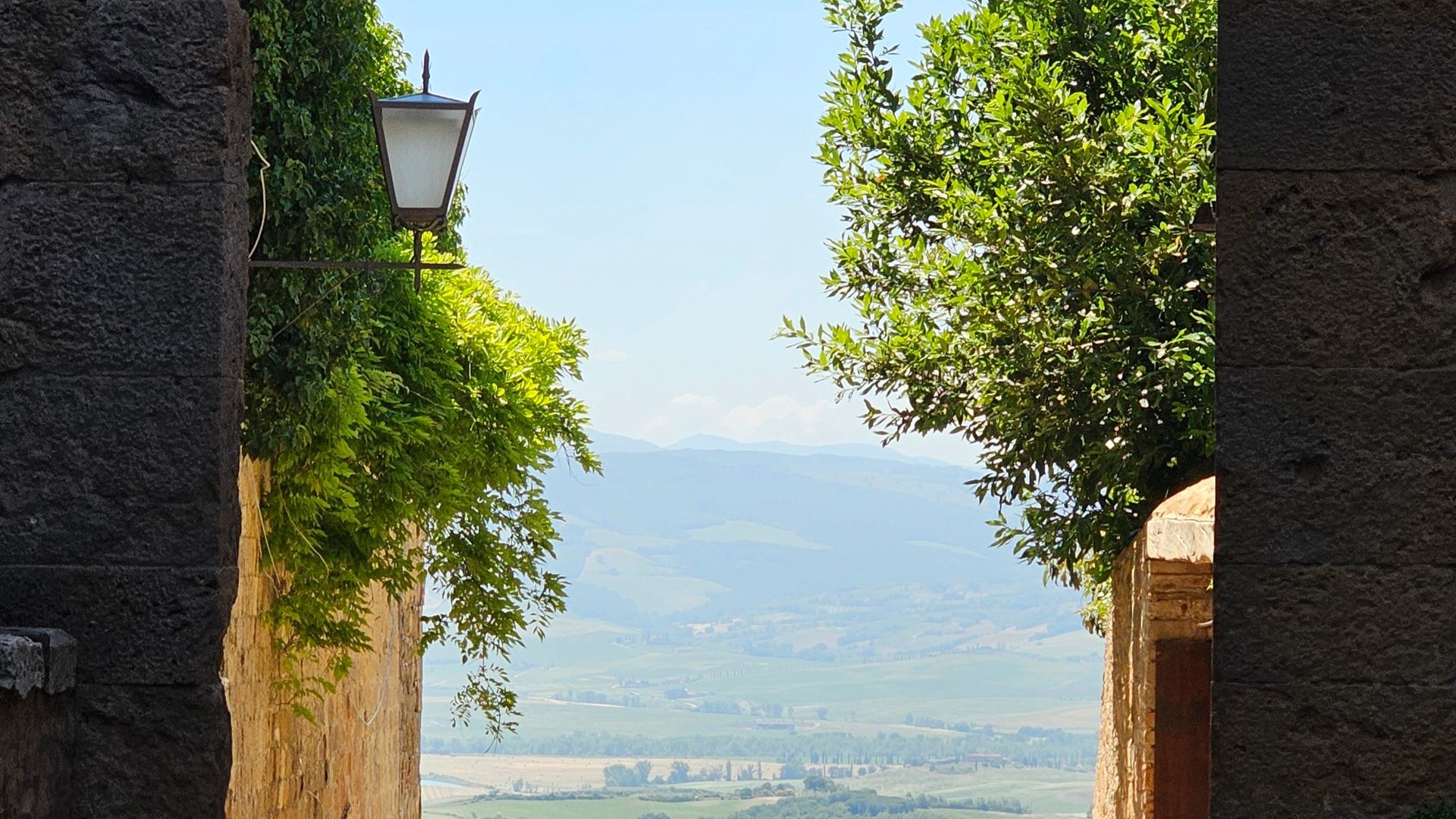
Of all the hill towns scattered across Tuscany’s wine country, Montalcino occupies a category of its own. This is not a stop you add to a Chianti day trip almost as an afterthought — it’s a destination in its own right, built almost entirely around a single, exceptional wine: Brunello di Montalcino, widely considered Italy’s most prestigious red and one of the most age-worthy wines produced anywhere in the world. If Chianti Classico is Tuscany’s approachable, everyday classic and Chianti Rùfina is its quiet, structured outlier, Montalcino is the region’s grand statement — bigger wines, longer aging requirements, and a landscape that feels a notch more dramatic than the softer hills further north.
Sitting roughly 1.5 hours south of Florence and about 45 minutes from Siena, Montalcino rewards a full day, and ideally an overnight, more than any other wine town in this part of Tuscany.
A Hilltop Town Built for Wine
Montalcino itself sits at roughly 560 meters above sea level, perched on a ridge with sweeping views over the Val d’Orcia to the south and the Asso and Ombrone river valleys elsewhere. The town predates the wine that made it famous by centuries — its imposing 14th-century Fortezza still dominates the skyline, and the medieval street plan hasn’t changed much since. But walk through the compact historic center today and it’s obvious what drives the local economy: wine shops, enotecas, and Brunello-branded everything line nearly every street, a reflection of just how completely this single wine has reshaped the town since Brunello earned Italy’s very first DOCG designation in 1980.
The Fortezza itself is worth the climb, both for the views and for the enoteca housed inside its walls, which pours a rotating selection from producers across the zone — a genuinely useful first stop for getting oriented before heading out to individual estates.
The Grape and the Rule That Makes Brunello Different
Brunello di Montalcino is made from 100% Sangiovese, specifically a clone historically known locally as „Brunello“ (meaning, roughly, „little dark one,“ a reference to the deep color of the grape). Unlike Chianti Classico, which permits small percentages of other grape varieties, Brunello allows none — it is Sangiovese in its purest expression, grown on a mix of soils across the zone ranging from galestro and clay in the north to more sandy, mineral-rich terrain in the south.
What truly sets Brunello apart, though, is the aging requirement written into the DOCG regulations themselves. By law, Brunello di Montalcino cannot be released until at least five years after the harvest, with a minimum of two years in oak and four months in bottle before release. Riserva bottlings require six years total. These are some of the strictest aging mandates of any wine region in the world, and they exist precisely because Sangiovese from this particular terroir has the tannic structure and acidity to genuinely benefit from that much time before it’s ready to drink — let alone the further decade or two many bottles can comfortably age afterward.
The Tiers Worth Knowing Before You Taste
Rosso di Montalcino
The „little brother“ of Brunello, made from the same grape and vineyards but released after just one year of aging. Fresher, more immediate, and considerably more affordable — often the best way to taste a producer’s house style before committing to a full Brunello.
Brunello di Montalcino
The standard bottling, released a minimum of five years after harvest. Full-bodied, structured, and built to age further — most producers‘ bread and butter, and the wine the entire zone is built around.
Brunello di Montalcino Riserva
Made only in exceptional vintages from a producer’s best fruit, aged a minimum of six years total. The pinnacle of the appellation, often produced in small quantities and priced accordingly.
Most estates will pour a flight moving through Rosso, Brunello, and, if you’re lucky, a Riserva side by side — an excellent way to feel the jump in weight and complexity that those extra years in the cellar actually deliver.
North vs. South: Two Very Different Sides of the Same Zone
One detail that surprises a lot of first-time visitors is just how much the Montalcino DOCG zone varies within itself. The north side of the appellation, closer to the town and at higher elevation, has cooler temperatures and more clay-heavy soils, producing Brunellos with brighter acidity, firmer tannin, and a more classically structured, age-worthy profile. The south side, sloping down toward the Val d’Orcia and closer to the warmer, Mediterranean-influenced air coming up from the coast, tends toward riper fruit, softer tannins, and wines that are more approachable earlier in their life.
Serious tasters often deliberately visit one estate on each side of town in a single day specifically to feel this contrast, since it says more about the region’s range than tasting two producers from the same corner of the zone ever could.
Visiting the Estates
Montalcino is home to well over 200 producers, ranging from historic, large-scale estates with international distribution to tiny family operations making only a few thousand bottles a year. Given Brunello’s price point and prestige, tastings here tend to be more formal and more likely to require advance booking than in Chianti — walk-in visits do happen, particularly at estates closer to town with a dedicated shop, but the best experiences almost always come from booking ahead, especially at smaller, more sought-after producers.
A typical visit runs an hour to ninety minutes: a walk through the cellar, often including barrels of Sangiovese at different stages of the mandatory aging process, followed by a seated tasting of two to four wines. Given how much of the pricing here rests on age and rarity, many estates are also happy to sell older vintages directly, something worth asking about if you’re building a small collection rather than just tasting for the afternoon.
Montalcino at a Glance
| Area | Character | Best For |
|---|---|---|
| Montalcino town | Fortezza, enotecas, walkable center | Orientation, a first flight, an overnight base |
| North zone | Higher, cooler, clay soils | Structured, classically age-worthy Brunello |
| South zone | Warmer, toward Val d’Orcia | Riper, more approachable styles |
| Sant’Antimo Abbey area | Historic abbey, quieter countryside | Combining culture with a tasting day |
Beyond the Vineyards: Sant’Antimo and the Val d’Orcia
Montalcino’s appeal isn’t limited to what’s in the glass. A short drive south of town sits the Abbey of Sant’Antimo, a strikingly beautiful Romanesque church built from pale travertine, still home to a small community of monks who perform Gregorian chant at certain services — a genuinely moving stop if the timing lines up, and a worthwhile detour even if it doesn’t.
Further south still, the town sits right at the edge of the Val d’Orcia, a UNESCO World Heritage landscape of rolling, almost impossibly photogenic hills, punctuated by the occasional lone cypress tree and hilltop farmhouse. Combining a Brunello tasting with even a short drive through this landscape, particularly in the late afternoon light, is one of the more memorable half-days this part of Tuscany has to offer.
Food: Built for Big Reds
Montalcino’s food culture leans into the same rustic, hearty Tuscan tradition as the rest of the region, but with a slight local specialty: wild boar (cinghiale) appears on menus constantly, whether as a ragù over pici, the thick, hand-rolled local pasta, or slow-braised and served alongside the kind of dense, unsalted Tuscan bread that’s meant to soak up every last bit of sauce. It’s a natural match for Brunello’s tannin and weight, and locals will often specifically recommend pairing an older bottle with a slow-cooked dish rather than something lighter.
Pecorino from the surrounding hills remains a constant here too, frequently aged longer and sharper than the versions found closer to Florence, standing up well to a mature Brunello’s intensity rather than getting lost next to it. For a lighter option between tastings, a simple plate of local salumi and a glass of Rosso di Montalcino makes for one of the most satisfying, unfussy lunches in the region.
Best Time to Visit
Harvest season, from mid-September through October, is arguably Montalcino’s finest window: the Val d’Orcia’s hills take on a golden, late-summer color, estates are at their busiest, and the town itself often hosts small local festivals tied to the harvest. Late spring, particularly May, offers similarly pleasant weather with fewer crowds and greener surrounding countryside.
Summer brings real heat, more intense here than in the cooler Chianti Rùfina hills further north, making early starts and shaded midday breaks worthwhile if a full day of estate-hopping is on the agenda. Winter is genuinely quiet, with many smaller estates operating by appointment only, but it pairs beautifully with the kind of slow, fireside meal that a mature Brunello is built for.
Owning a Piece of Val d’Orcia
Montalcino’s prestige comes at a price, and that extends to real estate — vineyard properties and restored farmhouses here command some of the highest values in rural Tuscany, a direct reflection of Brunello’s international reputation and the sheer photogenic pull of the surrounding Val d’Orcia landscape. That said, opportunities do appear, from smaller countryside homes without vineyard attached to larger estates that come to market when a family winery changes hands. For anyone whose Montalcino afternoon has drifted into daydreaming about a permanent foothold in this landscape, our real estate coverage is a sensible next stop.
Combining Montalcino with the Rest of a Tuscany Trip
Given the distance from Florence, Montalcino works best either as a full-day trip with an early start or, better still, as an overnight stop on a longer Tuscany itinerary that also takes in Chianti Classico and, for anyone chasing the full range of what Tuscan Sangiovese can be, the cooler, quieter hills of Chianti Rùfina. Tasting through all three in the same trip is genuinely one of the better ways to understand just how differently the same grape can behave across a relatively small stretch of Italian countryside.
If the itinerary eventually turns toward the coast, the contrast is worth planning for — Sicily’s best bays and coves for swimming, yachts, and boat trips makes a fitting second half to a trip that starts among Montalcino’s hilltop vineyards.
Sort Out Connectivity Before You Arrive
Montalcino’s more remote estates, particularly those tucked into the quieter southern half of the zone near the Val d’Orcia, can have patchy signal, and appointment confirmations are often handled by a quick message the morning of the visit. Landing without reliable data makes an already appointment-dependent day noticeably harder to manage. Setting up an eSIM before you travel takes a few minutes and solves this cleanly — our guide to staying connected with an eSIM walks through exactly how, and it’s worth doing before any day this reliant on booking ahead and finding your way down unmarked country roads.
The Takeaway
Montalcino asks more of a visitor than Chianti Classico or Chianti Rùfina do — more travel time from Florence, more advance planning for estate visits, and a wine that genuinely rewards patience both in the cellar and in the glass. In return, it offers arguably the single most impressive red wine tradition in Tuscany, a dramatic hilltop town built almost entirely around that tradition, and a landscape, in the Val d’Orcia stretching south, that ranks among the most beautiful in all of Italy. For anyone building a serious Tuscan wine trip, Montalcino isn’t optional. It’s the destination the rest of the itinerary should probably be built around.
0 Kommentare zu „Montalcino: Where Sangiovese Becomes Brunello“