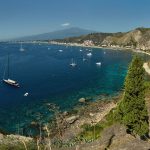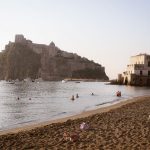
The Gulf of Trieste is the northernmost corner of the Mediterranean and unlike the rest of Italy’s coast. Limestone cliffs drop from the Karst plateau into clear green water, a Habsburg castle stands inside a marine reserve, and on summer evenings the city swims from the Barcola seafront. Within a short run you can be under the Duino cliffs, in the Grado lagoon or at lunch in Piran, Slovenia. The catch is the bora, a northeasterly that can turn a calm gulf rough quickly, so local knowledge counts.
This article contains affiliate links. If you book through them, we may earn a small commission at no extra cost to you. Read our affiliate disclosure.
Quick answer: Trieste and its gulf by boat
- Best departure harbour: Marina San Giusto in central Trieste for city stays; Portopiccolo at Sistiana for the cliffs, Duino and Grado.
- Best half day route: Trieste to Miramare along the Barcola coast, with a swim off the Costiera and back for sunset by the Molo Audace.
- Best full day route: Sistiana to the Duino cliffs, then across the gulf to the Grado lagoon with lunch in Grado.
- Best months: June and September; July and August are warmest but busiest.
- Book ahead: Boat and skipper, a berth if you arrive by sea, lunch tables in Piran or Grado, and anything around the Barcolana weekend in October.
Check prices and availability
Trieste’s waterfront hotels fill quickly in summer and Barcolana week. Check rooms before fixing your boat date.
This guide is part of our Italy by boat series. If you are heading south along the Croatian coast, our guide to Istria by boat picks up where this one ends.
Harbours and marinas: where boats leave from
Trieste Airport sits at Ronchi dei Legionari, north of the gulf, so the western harbours are quicker to reach than the city. Drive times are rough estimates.
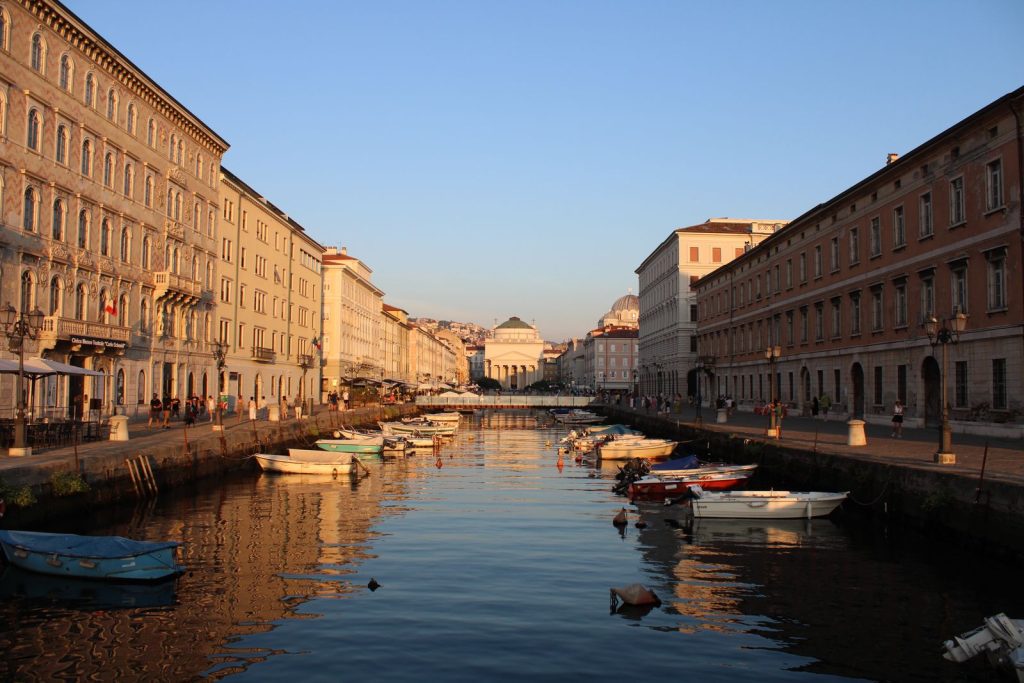
- Molo Audace and Marina San Giusto (central Trieste): the long stone pier opposite Piazza Unità d’Italia, with Marina San Giusto beside it. Confirm the exact pick up point with your skipper. Roughly 35 to 45 minutes from the airport. Best for: city based travellers, Miramare and Barcola, and Muggia.
- Porto San Rocco, Muggia: a large marina across the bay with 546 berths plus 52 transit berths, yachts up to 60 m, fuel and a four star hotel beside it. Best for: larger yachts and an easy hop to Piran and Umag.
- Grignano: the small harbour directly beside Miramare Castle, at the edge of the marine reserve. Best for: short trips and swimming along the Costiera.
- Sistiana and Portopiccolo: a sheltered bay with Portopiccolo, a resort village in a former quarry, and its marina for yachts up to 32 m. Roughly 20 minutes from the airport. Best for: Duino, Grado and a resort stay with the boat at the door.
- Duino and the Timavo mouth: a small harbour below Duino and marinas around Villaggio del Pescatore, closest to the airport. Best for: the cliffs and the run west to Grado.
The best routes in detail
Times assume a fast motor boat in calm conditions; sailing yachts take longer. Confirm timings with your skipper on the day.
Route 1: Miramare and the Barcola coast (3 to 4 hours, from central Trieste)
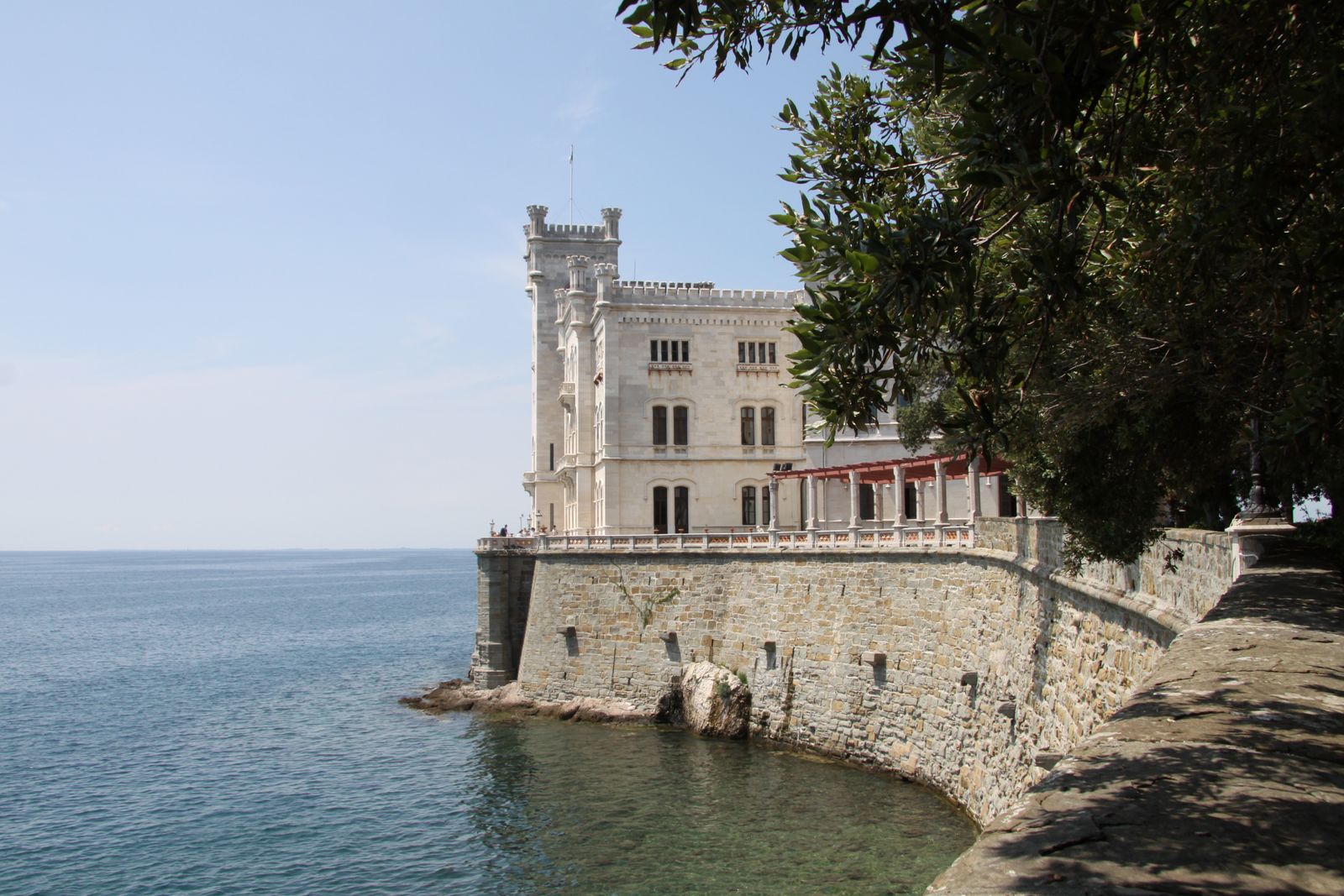
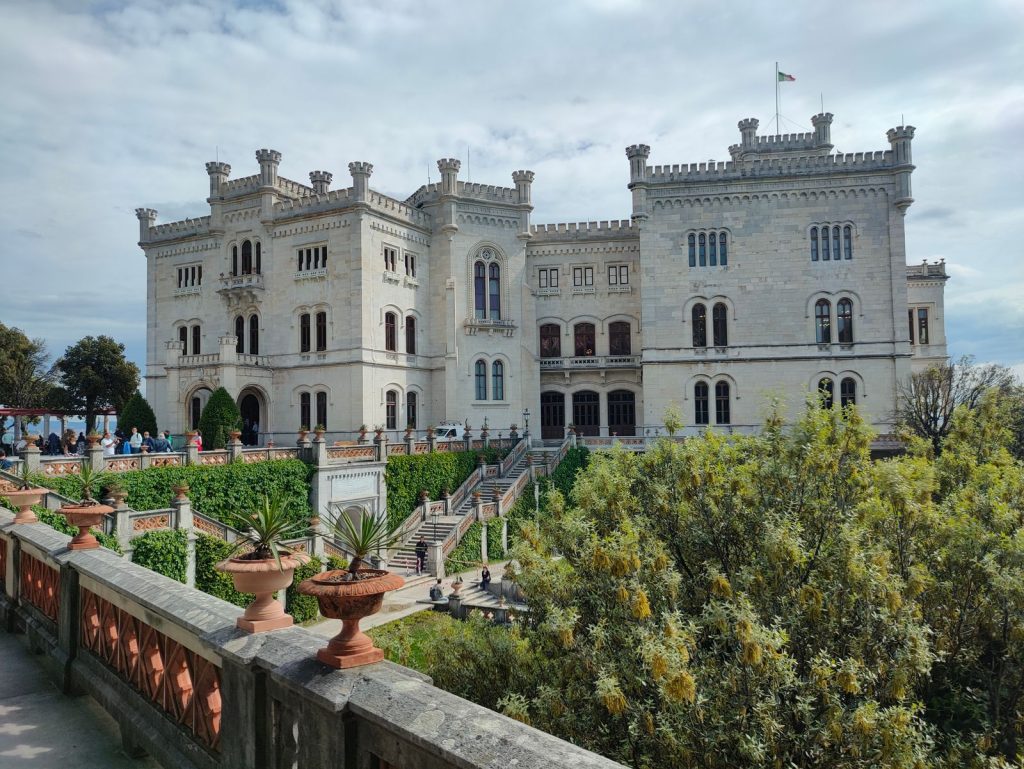
Follow the shore north past the old port and the Barcola seafront, where locals sunbathe on the platforms known as the Topolini. Miramare Castle, built for Archduke Maximilian of Habsburg, is roughly 4 nautical miles away, perhaps 15 to 20 minutes, and most striking from the water; stay outside the yellow reserve buoys (see the rules below). Continue past Grignano for a swim off the Costiera, below pebble beaches such as Canovella de’ Zoppoli, and return for sunset over Piazza Unità.
Lunch: on board, or ashore in Trieste afterwards. Swim stops: off the Costiera outside the reserve and the bathing areas.
Route 2: Sistiana, the Duino cliffs and the Rilke path (half day, from Sistiana or Portopiccolo)
Run northwest under the cliffs of the Duino nature reserve. Above them runs the Rilke path, the clifftop walk to Duino named after the poet who began his Duino Elegies at the castle, which stands on its headland beside the ruins of an older fortress. Parts of the water below are closed to boats and others have a strict speed limit, so your skipper sets the line. Allow roughly 15 to 25 minutes each way, then swim in the bay and walk the path in the afternoon.
Lunch: at Portopiccolo or ashore in Duino. Swim stops: the Bay of Sistiana and permitted areas off the cliffs.
Route 3: Across the gulf to the Grado lagoon (full day, from Sistiana, Duino or Trieste)
Grado is roughly 16 nautical miles from Trieste and closer from Duino, across the top of the gulf past the Isonzo river mouth reserve. Its old town of lanes and early Christian churches sits between the open sea and a shallow lagoon of reed beds, fishermen’s thatched huts and small islands, including the sanctuary island of Barbana. The channels are shallow, so you need a shallow draught boat and a skipper who knows them. Allow roughly 45 minutes to an hour each way from Trieste.
Lunch: ashore in Grado’s old town. Swim stops: the open sea side of Grado.
Route 4: Muggia and Piran in Slovenia (full day, from Trieste or Porto San Rocco)
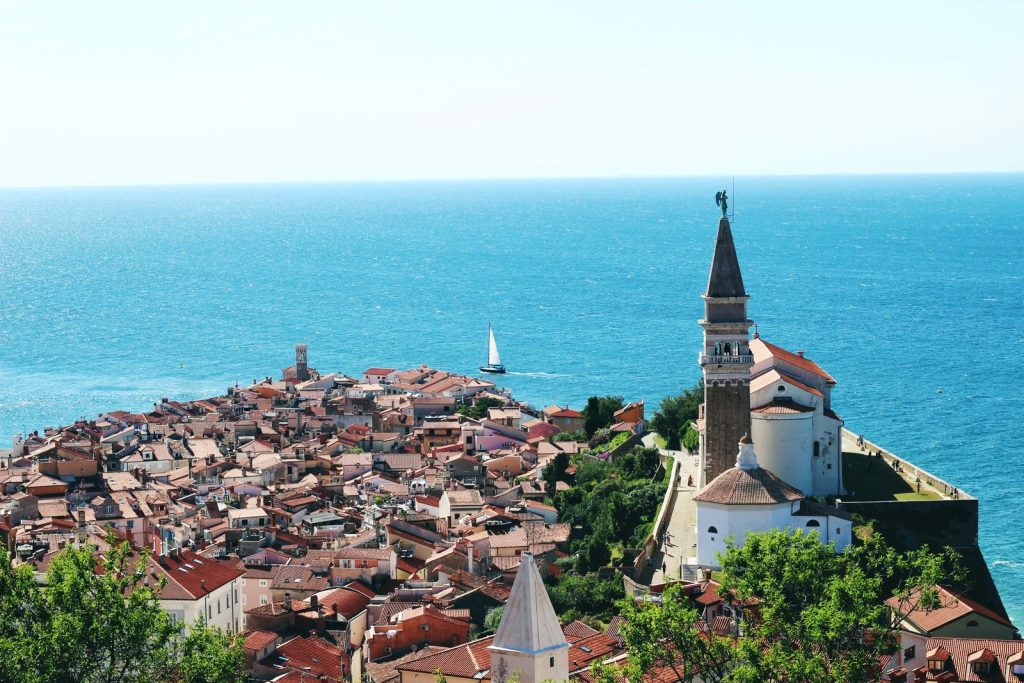
Cross the bay to Muggia, the small Venetian style town opposite Trieste, then follow the coast into Slovenia. Piran, roughly 11 nautical miles away, is a peninsula town of red roofs with a harbour square looking back towards Italy. There are no sea caves of note in this part of the gulf; for caves, look south to Istria. Allow 30 to 45 minutes each way.
Lunch: ashore in Piran. Swim stops: off the Slovenian coast where your skipper confirms it is allowed.
Route 5: Trieste to Umag and the Istrian coast (full day or overnight)
Umag in Croatia is around 16 nautical miles from Trieste. Croatia has its own rules and fees for arriving yachts, covered in our guide to crossing from Italy to Croatia by boat. It works best as the first leg of a few days in Istria.
Rules: marine reserves, anchoring and closures in 2026
The rules below come from official reserve and tourist board publications. Ordinances change, so confirm the current position with your skipper or the harbour office.
Miramare marine protected area
Established in 1986 and described by the Trieste tourist board as Italy’s first marine nature reserve, the area is managed by WWF Italy and marked by yellow buoys: a fully protected core of about 30 hectares close to shore and an outer area of about 90 hectares.
- Core zone: no navigation, no anchoring, no fishing and no independent swimming or diving. Snorkelling and sea watching inside the reserve are offered only with the reserve’s own guides, mainly in summer.
- Outer zone: fishing from the sea is banned. On boating and anchoring, our research turned up contradictory information: the Trieste tourist board says passage and anchoring are prohibited within the reserve, while a 2026 French sailing guide says navigation, anchoring and swimming are permitted in the outer zone and only the core is closed. It was not clear to us which applies, so keep outside the yellow buoys unless the reserve office or your skipper confirms otherwise.
- Fees: we found no published fee for boats; guided activities are booked through the visitor centre in the castle’s former stables.
Duino cliffs nature reserve
The regional reserve leaflet for the Falesie di Duino divides the water into three zones. Boats may not enter zone A or zone C at all, and fishing is banned in both. In zone B, boats may only enter up to 50 metres beyond the zone A buoy line, must travel at right angles to the coast rather than parallel to it, and may not exceed 5 knots. A separate harbour office ordinance bans any activity, on the surface or underwater, within 30 metres of the coast in zone A.
General rules along the coast
- Bathing areas: summer ordinances keep motor boats away from beaches; distances vary, so ask the skipper.
- Grado lagoon: stay in the marked channels and check local speed limits with the harbour office in Grado.
- Mooring: fees are set by each marina; book transit berths ahead in July, August and Barcolana week.
- Slovenia and Croatia: each has its own boating rules and fees; carry passports.
Closures and events in 2026
The Barcolana regatta, usually held on the second Sunday of October, fills the gulf with sailing boats. The organisers list Barcolana58 from 2 to 11 October 2026, with the main race on Sunday 11 October. On race day private boats must follow the harbour office’s instructions; the organisers sell official spectator trips aboard authorised boats.
Types of boat and what a skippered charter includes
- RIBs and small motor boats: quick and ideal for Miramare, Barcola and Duino, less comfortable in wind.
- Day cruisers and motor yachts: shade and a cabin; best for Grado or Piran.
- Sailing yachts: Trieste is a sailing city; plan shorter routes.
Typically included: the boat, the skipper, fuel within an agreed range, snorkelling gear, soft drinks and water. Often excluded: extra fuel for longer routes, lunch ashore, mooring fees in Grado or Piran, any guided activities, and the skipper’s meals on a long day. Ask for a written list before paying a deposit.
Licence free hire: Italian rules allow you to drive a boat without a licence if the engine is no more than 30 kW (about 40 hp), within further engine size limits, and you stay within six nautical miles of the coast. Jet skis always need a licence. Given the bora and reserve boundaries, a skipper is wiser.
Routes at a glance
| Route | Departure | Duration | Highlights | Best for |
|---|---|---|---|---|
| Miramare and Barcola | Trieste centre | 3 to 4 hours | Castle from the sea, Costiera swim, sunset | City stays, first timers |
| Duino cliffs | Sistiana, Portopiccolo | Half day | Cliffs, Duino Castle, Rilke path | Resort guests, walkers |
| Grado lagoon | Sistiana, Duino, Trieste | Full day | Old town, lagoon islands, Barbana | Families, nature lovers |
| Muggia and Piran | Trieste, Porto San Rocco | Full day | Two countries, lunch in Piran | Couples, food lovers |
| Umag and Istria | Trieste, Porto San Rocco | Full day or longer | Start of a Croatian coast trip | Multi day charters |
Best months, winds and practical tips
June and September bring warm water and fewer boats. July and August are warmest and busiest, especially at weekends in Barcola and Sistiana. October belongs to the Barcolana.
The bora is the wind to respect. It blows from the northeast off the Karst, strongest in the colder months, when local news regularly reports gusts around 100 km/h in Trieste. It can also blow in summer. Because it is offshore, water near the city can look calm while it is rough further out. If bora is forecast, accept your skipper’s advice to shorten or move the route.
- Bring: sun protection, a windproof layer, water shoes and passports.
- Seasickness: the morning is usually calmest; choose a larger boat for the open crossing to Grado or Piran.
- Booking: for August and Barcolana weekend, book months ahead.
- Combine it: the Collio vineyards are inland; see our Collio and Friuli wine guide.
Charlotte’s tip: build in a bora day
Book the boat for the first full day of your stay and keep the next one free. If the bora blows, swap to Miramare’s gardens or a Collio wine lunch and sail the following day.
Check prices and availability
Compare Trieste’s waterfront hotels and the resorts along the coast for your dates.
Where to stay near the harbours
Grand Hotel Duchi d’Aosta, Trieste
A historic hotel on Piazza Unità d’Italia, a few steps from the Molo Audace and Marina San Giusto. Our research turned up contradictory information on its size: current listings give 37 rooms and suites, with some adding a few apartments, so confirm the room type with the hotel. Many rooms overlook the square or the gulf, and there is Harry’s restaurant and bar and an indoor heated pool with sauna and Turkish bath.
Best for: couples who want the city and the boat in one.
Check rates at Grand Hotel Duchi d’Aosta
Savoia Excelsior Palace, Trieste
A grand waterfront palace on the Riva del Mandracchio, about three minutes’ walk from Piazza Unità and the Molo Audace. It has 144 rooms, sea views in several categories, a restaurant, spa treatments and a gym; confirm a sea view at booking.
Best for: larger rooms and a classic seafront stay.
Check rates at Savoia Excelsior Palace
Hotel Riviera & Maximilian’s, Grignano
On the Strada Costiera roughly 1 km from Grignano harbour, close to Miramare. It has 59 rooms, a lift down to its own bathing area, the Le Terrazze restaurant and a sauna. Ask the hotel about seasonal opening.
Best for: Miramare and Costiera swimming, away from the city.
Check rates at Hotel Riviera & Maximilian’s
Tivoli Portopiccolo Sistiana Wellness Resort & Spa, Sistiana
Formerly Falisia, the resort sits inside Portopiccolo, a short walk from the marina and about 20 minutes from the airport. It has 58 rooms including 20 suites, a 3,600 square metre spa, several pools and a beach club. Ask about winter opening.
Best for: Duino, Grado and a resort stay with the boat on the doorstep.
Check rates at Tivoli Portopiccolo
For a vineyard night inland, see our Castello di Spessa review.
Frequently Asked Questions
Can you swim at Miramare Castle?
Not in the fully protected core of the reserve, except on guided snorkelling run by the reserve. Swim off the Costiera outside the yellow buoys instead.
When is the Barcolana in 2026?
Barcolana58 runs from 2 to 11 October 2026, with the main race on Sunday 11 October.
Can I visit Slovenia and Croatia in one boat day from Trieste?
Piran is an easy day; Umag is better as part of a few days in Istria.
Do I need a licence to hire a boat in Trieste?
Not for engines up to 30 kW (about 40 hp) within six nautical miles of the coast. Anything larger needs a licence or a skipper.
Planning more of the Adriatic by boat?