
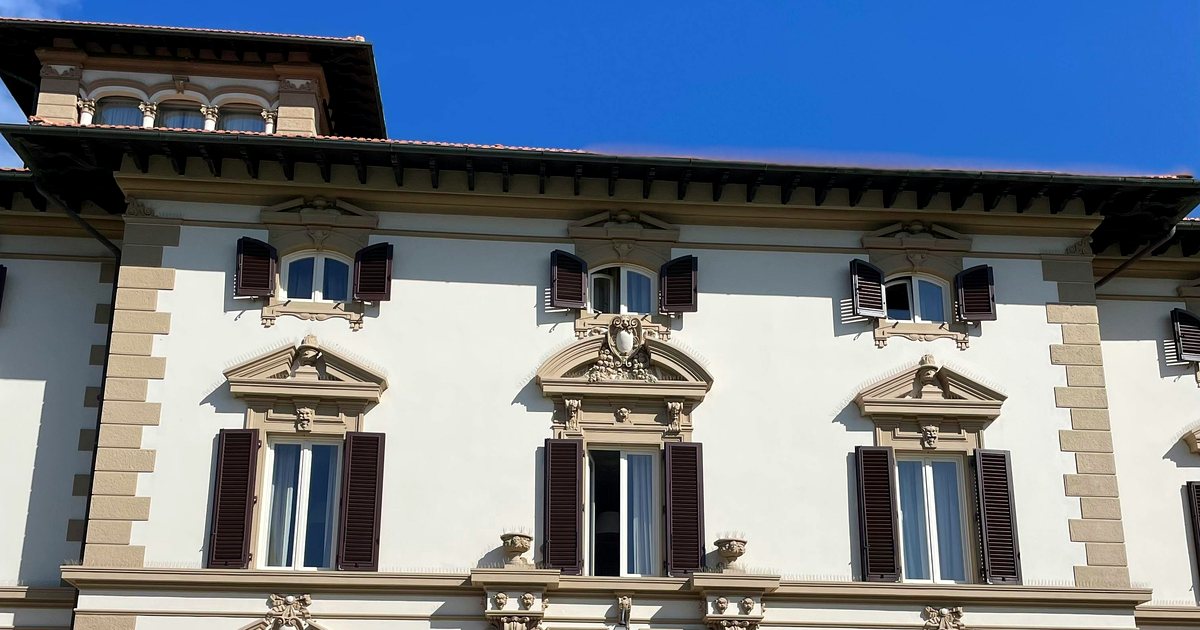
There is a moment, arriving at Villa Cora, when Florence does something unexpected: it disappears. The noise of the city, the crowds at the Pitti Palace three minutes away, the scooters on the lungarno — all of it gone. What remains is a 19th-century neo-classical villa of extraordinary beauty, a garden in full bloom, and a view across the entire city that no five-star hotel in the centro storico can match.
Villa Cora is one of those rare properties where the building itself is the experience. Not a backdrop, not a branded shell with period features preserved in glass cases — a living aristocratic residence that has housed an Empress, hosted some of the most celebrated events in Florentine social history, and is now, by a remarkable stroke of fortune, available by the night. This is the complete guide to staying here properly.
|
1865
year the villa was built
|
47
rooms and suites
|
3 min
walk to Boboli Gardens
|
€650+
per night from
|
Villa Cora was built in 1865 for Baron Oppenheim, a German banker of considerable wealth and social ambition, who chose the hillside above the Oltrarno — with its commanding views over Florence and its proximity to the Boboli Gardens — as the site for a residence that would announce his arrival in Florentine society with appropriate force. The architect delivered a neo-classical villa of theatrical grandeur: colonnaded facades, frescoed ballrooms, gilded salons, and a garden designed to be seen from every room.
Its most famous resident was Empress Eugénie de Montijo — wife of Napoleon III, one of the most celebrated women in 19th-century Europe, and the de facto arbiter of European fashion for two decades. After the fall of the Second French Empire in 1870, Eugénie spent periods in exile across Europe, and Villa Cora was among her chosen residences in Florence. The association transformed the villa’s status: what had been an impressive banker’s house became one of the most socially significant addresses in the city.
Over the following century the property passed through several hands, served various institutional purposes, and underwent the usual cycle of decline and restoration that characterises Italy’s great historic buildings. Its transformation into a luxury hotel has been managed with unusual sensitivity: the architectural fabric — the frescoes, the stucco, the marble floors, the gilded ceilings — has been preserved rather than replicated, and the result is a building that reads as genuinely historic rather than period-pastiche.
| Year | Event |
|---|---|
| 1865 | Built for Baron Oppenheim on the Oltrarno hillside above Boboli. Neo-classical design with frescoed ballrooms and panoramic garden. |
| 1870s | Empress Eugénie de Montijo — wife of Napoleon III — uses the villa as a residence during her years of exile from France after the fall of the Second Empire. |
| Late 19th C | Villa becomes a centre of Florentine aristocratic and expatriate social life during the Belle Époque period. |
| 20th C | Various ownership; at points used as institutional residence. Original architectural fabric largely preserved through neglect as much as intention. |
| 2012 | Restoration completed and Villa Cora opens as a luxury hotel. Frescoes, gilded ceilings, and marble floors preserved throughout. Pool terrace added with panoramic city view. |
The villa’s architecture belongs to a specifically Italian strain of 19th-century neo-classicism — grander than its French equivalents, more decoratively exuberant than its German counterparts, and deeply influenced by the Renaissance buildings it overlooks from the hillside. The facade is formal but not austere; the interiors are a sequence of rooms that move from the public grandeur of the ballroom and the gilded salon to the more intimate scale of the guest rooms above.
The frescoed ceilings are the building’s defining interior feature. Throughout the piano nobile — the principal floor, where the most important public rooms are located — ceiling frescoes survive in varying states of preservation, their subjects drawn from classical mythology and allegory in the tradition of 19th-century aristocratic decoration. They are not the Renaissance masterpieces of the Uffizi or the Duomo; they are something more intimate: the private visual world of a family that wished to live, daily, inside beauty.
Where timeless frescoes meet blooming artistry, Villa Cora becomes the perfect stage for floral excellence.
This wasn’t just decoration.
It was vision, sculpted through textures, tones and movement.The floral designer transformed every corner into… pic.twitter.com/oUefQz3CTt
— Lauren Ashley Grenda | Chicago Wedding P (@laurenashley853) May 25, 2026
The frescoed rooms of Villa Cora have also made it one of the most sought-after event venues in Florence — a fact that becomes immediately comprehensible in person. The ballroom, in particular, is one of those spaces that defeats description and simply has to be experienced: a room where every surface carries decoration, where the proportions are calculated for magnificence, and where the combination of gilded plasterwork, fresco, and chandelier light creates something that no contemporary interior design can replicate because it was never designed at all — it accumulated, over decades, as an expression of a family’s wealth and taste.
Staying online abroad no longer means hunting for a local SIM card at a chaotic kiosk. This guide compares the best eSIM providers for international travelers.
Florence is a city best understood from above. The terracotta roofline, the Duomo’s dome rising from the centre, the hills of Fiesole in the distance and the beginning of the Chianti to the south — all of this becomes legible when you step back far enough to see it whole. Villa Cora’s position on the Oltrarno hillside — immediately above the Boboli Gardens, at the same elevation as the Piazzale Michelangelo — gives it one of the finest elevated views of the city available from any hotel in Florence.
The pool terrace is where this view is best experienced. In summer, with the water reflecting the sky and the city spread below, it is an almost absurdly beautiful place to spend an afternoon. In the early morning — before the heat arrives and before other guests have surfaced — it is something even better: quiet, cool, and possessed of a stillness that Florence at street level cannot offer.
The rooms facing the city share this view to varying degrees depending on their floor and position. Booking a city-view room is not optional — it is the point. The difference between a garden-facing and a city-facing room at Villa Cora is the difference between a very good stay and an exceptional one.
| Room type | From / night | Standout feature | Verdict |
|---|---|---|---|
| Deluxe Room | ~€650 | Original period furnishings, high ceilings | Specify city view when booking — worth the supplement |
| Superior Room | ~€800 | Larger footprint, city or garden view | The right entry point for a 2–3 night stay |
| Junior Suite | ~€1,100 | Separate sitting area, frescoed or coffered ceiling | The sweet spot — space, character, and city views combined |
| Suite | ~€1,600 | Full living room, original architectural details throughout | For those who want to feel genuinely resident in the building |
| Eugénie Suite | ~€2,400+ | Named for the Empress; the villa’s finest room, panoramic city views, original period decoration | The definitive Villa Cora experience — book months ahead |
The hotel’s restaurant — Bistrot — occupies one of the villa’s ground-floor rooms, with access to the terrace in warmer months. The cooking is Tuscan at heart: Chianina beef, seasonal vegetables from the market at Santo Spirito, pasta made daily, and a wine list that draws intelligently on the surrounding landscape — Chianti Classico, Morellino, Vernaccia, and a selection of producer wines unavailable in most city restaurants.
The Terrace Bar is the real draw — particularly at aperitivo hour, when the city below begins to glow in the late-afternoon light and the Duomo’s silhouette sharpens against whatever the Florentine sky is doing that evening. It is one of the finest places in the city to drink a glass of something cold and think about nothing in particular. Reserving a terrace table in advance — particularly for sunset — is strongly advised in high season.
The outdoor pool sits on a raised terrace with direct views over Florence — a position that makes it, by some margin, the most visually spectacular hotel pool in the city. Unlike the Four Seasons garden (which is vast, enclosed, and deliberately removed from the city), Villa Cora’s pool terrace is oriented towards Florence — the city is the backdrop, the view is the amenity, and on a clear day you can trace the line of the Arno from the pool’s edge all the way to where it disappears into the hills east of the city.
The spa occupies part of the villa’s lower level — smaller than the facilities at the Four Seasons or the Savoy, but well-equipped for a property of this scale, with treatment rooms, steam, and a small indoor pool for off-season or early-morning use. The garden surrounding the villa is immaculately kept: clipped box hedges, rose beds, lemon trees in terracotta pots, and the kind of ordered Italianate formality that feels, in the context of this building, entirely correct.
Villa Cora sits on the Viale Machiavelli — a broad tree-lined avenue immediately above the Boboli Gardens — in a position that is simultaneously close to the city’s major attractions and entirely removed from its tourist infrastructure. The Pitti Palace is a three-minute walk downhill. The Ponte Vecchio is twelve minutes on foot. The Oltrarno’s finest restaurants, wine bars, and artisan studios are within walking distance; the centro storico’s major museums and monuments are a short taxi or tram ride away.
| Destination | Distance / time on foot |
|---|---|
| Boboli Gardens (entrance) | 3 min |
| Pitti Palace | 5 min |
| Piazzale Michelangelo | 8 min |
| Santo Spirito (wine bars, restaurants) | 12 min |
| Ponte Vecchio | 15 min |
| Uffizi Gallery | 20 min / 8 min by taxi |
| Duomo complex | 25 min / 10 min by taxi |
|
Always book city-view
The view of Florence from a city-facing room at Villa Cora is the reason to stay here over any comparable property. A garden-facing room at a lower rate is a false economy — the view is the experience.
|
Terrace at sunset
Reserve a terrace table for aperitivo around 7pm. The light on the city at this hour — particularly in late spring and autumn — is the finest Florence has to offer. Order a Negroni and plan nothing else for an hour.
|
|
Best season
May–June and September–October. The garden and pool terrace are at their finest in spring; the autumn light on the city is extraordinary. July and August are hot and rates peak; winter offers the best value and empty Boboli Gardens.
|
The Eugénie Suite
Named for the villa’s most famous guest and decorated in keeping with its history — the finest room in the building, with the most complete view of the city. Sells out months ahead in high season. Book early or not at all.
|
Villa Cora is not the right hotel for everyone visiting Florence. It is not the most central. It does not have the garden scale of the Four Seasons or the Arno-side discretion of Portrait Firenze. If you need to be within five minutes of the Uffizi at all hours, the Savoy is the more logical choice.
But for a specific kind of traveller — one who values the historic building over the brand, the view over the location, and the romance of a villa where an Empress once lived over the efficient luxury of a contemporary hotel — Villa Cora is irreplaceable. There is no other property in Florence that offers this combination: a genuinely historic neo-classical villa, intact frescoed interiors, and a pool terrace from which the entire city is laid out below you like a painted map.
It is, in the most precise sense, the most romantic hotel in Florence. And in a city built on beauty, that is not a small thing.
Empress Eugénie chose this hillside for a reason. The view has not changed. The villa has barely changed. The city below is the same one she looked out over in the 1870s, the Duomo rising from the same terracotta plain, the hills behind it the same blue-grey in the evening light. Some things endure. Villa Cora is one of them.
luxury hotel Oltrarno
Empress Eugénie Florence
neo-classical villa Florence
Florence pool view hotel
best romantic hotel Florence
Florence 5-star hotel 2026
Boboli Gardens hotel
luxury Italy travel 2026
frescoed villa hotel Tuscany
0 Kommentare zu „Villa Cora, Florence: The Neo-Classical Villa Where an Empress Slept — and the View That Changes Everything“