
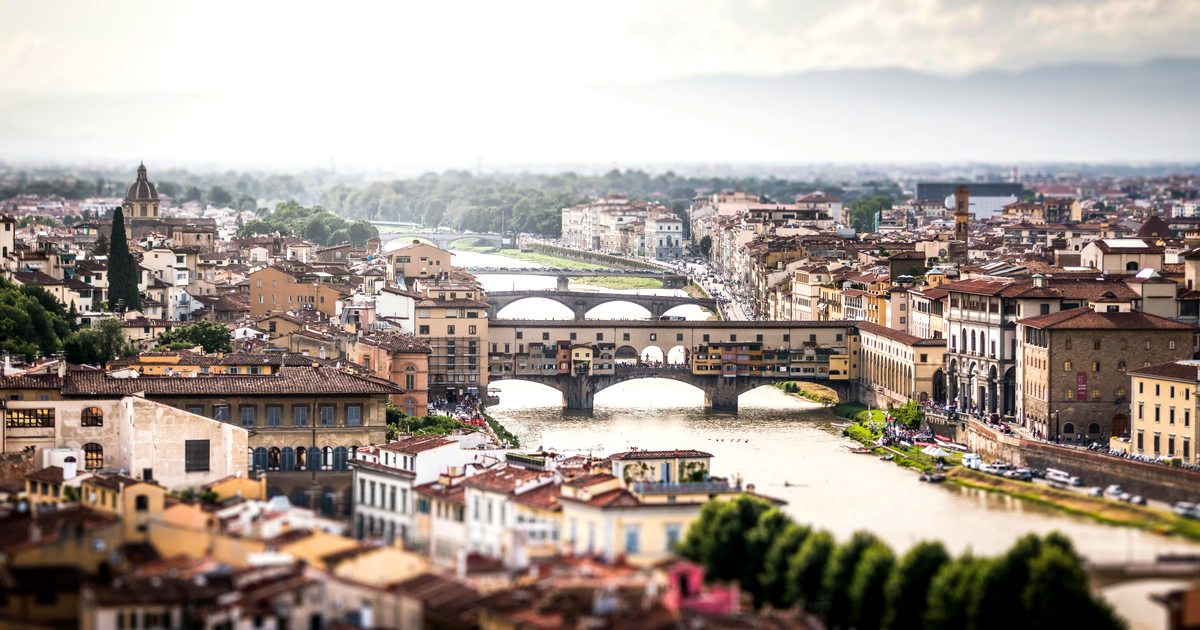
Buying property in Florence is not simply a real estate transaction. It is an act of alignment — with a city, a landscape, a way of living that has remained, in its essentials, unchanged for five centuries. The question serious buyers are asking in 2026 is not whether Florence represents good value. It is whether they can still find the right property before others do.
This guide covers the Florentine and Tuscan property market in full — from centro storico apartments and Oltrarno palazzi to Chianti farmhouses, Fiesole villas, and the coastal estates of the Maremma. It includes current price data, neighbourhood breakdowns, the Italian Flat Tax regime, and the practical steps foreign buyers need to know.
|
€6–12k
per m² top districts
|
€100k
flat tax per year for foreign residents
|
15 yrs
maximum flat tax duration
|
+18%
prime Florence prices since 2020
|
The Florentine property market has undergone a structural shift over the past five years that shows no sign of reversing. What was once a market driven almost entirely by Italian buyers — with the occasional American or Northern European making a holiday-home purchase — has become genuinely international. British, Swiss, American, and Scandinavian buyers now represent a significant share of transactions at the premium end, and the reasons are not hard to understand.
Remote work has decoupled residence from employment for a generation of high earners. Italy’s Flat Tax regime offers foreign residents a €100,000 annual ceiling on tax from all foreign-sourced income — an extraordinary advantage for those with investment portfolios, business income, or pension assets based abroad. And Florence itself offers something that money can rarely simply purchase: a living city of extraordinary cultural depth, walkable scale, and Michelin-starred cuisine, set within thirty minutes of Europe’s finest wine landscape.
The supply constraint is real. The centro storico is a UNESCO World Heritage Site; new construction within it is effectively impossible. The stock of genuinely desirable historic properties — piano nobile apartments with frescoed ceilings, rooftop terraces overlooking the Duomo, private courtyards behind medieval street facades — is finite and diminishing as buyers hold rather than sell. Those who bought in 2018 or 2019 have seen values rise substantially. Those considering a purchase in 2026 are doing so at higher prices — but still at a significant discount to comparable cities in Switzerland, the UK, or the French Riviera.
Florence is a compact city, and its premium residential geography is correspondingly concentrated. The following breakdown covers the key areas for serious buyers, from the historic core to the hills above the city.
| Neighbourhood | Price range / m² | Character | Best for |
|---|---|---|---|
| Santo Spirito | €7,000 – €12,000 | Oltrarno’s finest square. Authentic, residential, artisan studios alongside excellent restaurants | Buyers who want local life over tourist traffic |
| San Niccolò | €6,500 – €11,000 | Below the Piazzale Michelangelo. Views, quieter streets, proximity to the Arno | Those seeking views and residential quiet |
| Santa Croce | €6,000 – €10,500 | East of the Duomo. Mixed residential and cultural. The most authentic north-bank neighbourhood | Value within the centro storico |
| Piazza d’Azeglio / SS Annunziata | €8,000 – €13,000 | Florence’s most elegant residential square. Large apartments in historic palazzi. Quiet, prestigious | The most prestigious address in the city |
| Via Tornabuoni / Centro | €9,000 – €15,000+ | Premium commercial and residential. Flagship fashion houses below, grand apartments above | Trophy assets, pied-à-terre buyers |
| Fiesole | €4,500 – €9,000 | Hilltop village above Florence. Villas with private gardens, pool, panoramic city views. 20 min drive | Full-time residents, families, long-term base |
| Settignano / Arcetri | €3,500 – €7,500 | Quiet hillside villages east and south of Florence. Olive groves, stone villas, old-money atmosphere | Privacy, space, and genuine rural character |
|
Oltrarno
Santo Spirito & San Niccolò
The south bank of the Arno is Florence’s most sought-after residential quarter for buyers who want authentic city life rather than proximity to tourist crowds. Santo Spirito’s piazza — the finest in the Oltrarno — anchors a neighbourhood of artisan studios, wine bars, and restaurants that serve a genuinely local clientele. Properties here are mostly in restored Renaissance and Baroque palazzi; ground-floor units with private courtyard access command a premium of 15–25% above equivalent upper floors.
|
North Bank
Piazza d’Azeglio & SS Annunziata
Florence’s most prestigious residential address. Large apartments in 19th-century palazzi around the city’s most perfectly proportioned square. The neighbourhood is genuinely quiet — a remarkable quality so close to the Duomo — and retains a patrician Florentine character. Piano nobile floors with original frescoed ceilings and terrazzo flooring are the most sought-after assets. Supply is extremely limited.
|
|
Hills above Florence
Fiesole & Settignano
The hillside villages above Florence have attracted wealthy residents since the Roman era — Boccaccio, Leonardo, and later Bernard Berenson all lived here. Villas in Fiesole command panoramic views over the Arno valley and the city’s terracotta rooftops, with private gardens, pools, and the privacy impossible in the centro. The drive to Florence takes twenty minutes; the psychological distance is considerably greater, which is precisely the point.
|
Chianti countryside
Rural estates & poderi
The farmhouses and estates of the Chianti zone — 30 to 60 minutes south of Florence — represent a fundamentally different proposition. A fully restored podere with land, outbuildings, a pool, and olive groves is both a lifestyle asset and, where agriturismo income or wine production is established, a functioning business. Prices vary enormously by condition, location, and the presence of income-generating features.
|
Since 2017, Italy has operated a Forfettario regime for high-net-worth individuals who transfer their tax residence to Italy. Under this scheme, all income produced outside Italy is subject to a single annual flat tax of €100,000, regardless of the amount. Foreign-source capital gains, dividends, interest, rental income, and business income are all covered. The regime lasts for up to 15 years and can be extended to family members for €25,000 per person per year.
For an individual with, say, €2 million in annual foreign investment income, the difference between paying Italian standard income tax rates (up to 43%) and the flat €100,000 is enormous. This has directly driven demand from wealthy foreign buyers — particularly those from high-tax jurisdictions in Northern Europe and the UK — who can restructure their lives around Italian residency without surrendering their international income base.
| Parameter | Detail |
|---|---|
| Annual flat tax | €100,000 on all foreign-sourced income, regardless of amount |
| Family extension | €25,000 per additional family member included in the scheme |
| Maximum duration | 15 years |
| Income covered | All foreign-source income: dividends, interest, capital gains, rental income, business income |
| Italian-source income | Taxed at standard Italian rates (separate from the flat tax) |
| Eligibility requirement | Must not have been Italian tax resident in the 9 of the preceding 10 years |
| Introduced | 2017. Regime remains active as of 2026; specialist advice strongly recommended before application |
|
Most sought-after
Piano nobile apartment
€900k – €4M+
The first floor above street level in a Renaissance or Baroque palazzo — historically the noble family’s principal residence, with the highest ceilings, finest stonework, and most elaborate decorative schemes. Frescoed ceilings, original terrazzo floors, tall windows opening onto the street. These are the most culturally significant residential assets in the city and the most consistently desirable among serious buyers.
|
Urban prestige
Palazzo floor / full floor
€2M – €8M+
Entire floors of historic palazzi — or in some cases entire palazzi — occasionally reach the market, usually from estates or family restructurings. These are true trophy assets: 400–800 sqm of historic space, often with internal courtyards, original architectural detailing, and provenance stretching to the 14th or 15th century. The rarest category and the most internationally competitive in terms of buyer demand.
|
|
Urban residential
Renovated centro storico apartment
€400k – €1.2M
The largest segment of the premium market: apartments of 60–150 sqm in historic buildings, fully renovated to modern standards while retaining period features. Quality of renovation varies significantly — buyers should verify building fabric, systems, and Soprintendenza compliance independently. Rooftop terraces and private garden access command a 20–35% premium.
|
Country & rural
Chianti farmhouse / podere
€700k – €3M
Restored stone farmhouses with land — typically 1 to 5 hectares — outbuildings, pool, olive groves, and in some cases vineyard. The best examples are fully compliant agriturismo operations generating rental income. Buyers should assess water supply, road access, and the condition of outbuildings carefully; renovation costs on rural properties can be substantial and unpredictable.
|
Italian property law is well-established and transparent. The conveyancing process is handled by a notaio — a state-appointed notary with independent legal responsibility for both parties. For foreign buyers, the key is assembling the right professional team before beginning the search.
| Step | What happens | Typical timeline | Key note |
|---|---|---|---|
| 1. Codice Fiscale | Obtain Italian tax identification number — required for all legal and financial transactions | 1–3 days | Available at Italian consulates abroad or Agenzia delle Entrate in Italy |
| 2. Proposta d’acquisto | Written offer, typically with a deposit of 1–3% of purchase price | Days | Legally binding once accepted. Engage a lawyer before this stage |
| 3. Compromesso | Preliminary contract — detailed terms agreed, deposit of 10–20% paid | 2–8 weeks | If seller withdraws, buyer receives double the deposit back. If buyer withdraws, deposit is forfeited |
| 4. Survey / due diligence | Independent geometra (surveyor) reviews structure, planning compliance, Soprintendenza records | 2–4 weeks | Critical for historic properties — always commission independently, not through the selling agent |
| 5. Rogito (completion) | Final deed signed before the notaio, full balance paid, title transferred | 1–3 months after compromesso | Notaio fees typically 1–2.5% of declared value. Buyer pays; notaio is neutral |
| 6. Registration & taxes | Property registered, taxes paid (varies: 2–9% of cadastral value depending on property type and buyer status) | Simultaneous with rogito | Prima casa (primary residence) rate of 2% applies if establishing residency in Italy |
Buying a property that requires renovation in Florence’s centro storico is a fundamentally different proposition from renovation in most other cities. The Soprintendenza Archeologia, Belle Arti e Paesaggio — Italy’s heritage authority — has jurisdiction over any work affecting the exterior of a building in the historic centre, and in many cases over significant interior works as well.
This does not make renovation impossible — thousands of Florentine properties have been beautifully restored — but it adds a layer of bureaucratic process, specialist expertise, and time that buyers must budget for honestly. A project that might take 12 months in London or Paris may take 24 to 36 months in Florence, not because of contractor delays but because of the permitting timeline with the Soprintendenza.
| Scope | Cost per m² | Notes |
|---|---|---|
| Light cosmetic refurbishment | €400 – €800 | Decorating, kitchen and bathroom update, no structural work |
| Full interior renovation | €1,200 – €2,500 | New systems (electrical, plumbing, heating), full fit-out. Historic buildings at upper end |
| Structural + full renovation | €2,500 – €4,500+ | Seismic reinforcement, Soprintendenza-compliant restoration of historic fabric |
| Rural podere (full restoration) | €1,500 – €3,000 | Stone structure, roof, systems, finishes. Budget for unexpected discoveries in older rural buildings |
The turn-key premium: A fully renovated, Soprintendenza-compliant property in the centro storico commands a significant premium over an unrenovated equivalent — typically 30–50% above raw cost. For many buyers, this premium makes economic sense: the renovation risk, timeline, and expertise required to do it properly are substantial, and the turn-key price reflects not just the works but the management of a complex process.
| Market | Prime price / m² | Flat tax | Liveability | Verdict |
|---|---|---|---|---|
| Florence | €9,000–15,000 | Yes — €100k / yr | Exceptional | Best value for cultural depth and tax efficiency combined |
| Paris (7th/8th) | €18,000–28,000 | No | High | 2–3x the price, full French tax burden |
| French Riviera | €12,000–25,000 | No | Seasonal | Higher prices, no tax advantage, limited year-round culture |
| Lisbon (Príncipe Real) | €6,000–10,000 | NHR (modified) | Good | Comparable price but shallower cultural depth; NHR regime now less favourable |
| Rome (Parioli / Prati) | €7,000–14,000 | Yes — same regime | Complex | Same tax advantage; less walkable, more chaotic daily life |
No city in Europe offers the same combination of investment fundamentals, lifestyle quality, and tax efficiency as Florence in 2026. The supply of genuinely historic property is finite and declining. The tax regime is the most favourable in Western Europe for high-net-worth foreign residents. The city itself — walkable, beautiful, culturally inexhaustible — continues to draw the kind of permanent international residents who buy, improve, and hold rather than flip.
The buyers who purchased in the Oltrarno or in Fiesole a decade ago made what looks, in retrospect, like an obvious decision. The buyers considering Florence in 2026 are faced with higher prices — but also with a market that has demonstrated consistent, sustained appreciation and a city that shows no sign of losing its fundamental appeal.
Buying in Florence is not simply acquiring a property. It is taking a position — on a city, a way of living, and a landscape that has rewarded intelligent attention for five hundred years.
buy property Florence
Italian flat tax
luxury Tuscany property
Chianti farmhouse
Fiesole villa
piano nobile apartment
Oltrarno property
Italy property for foreigners
notaio Italy buying process
centro storico UNESCO
Soprintendenza renovation Italy
0 Kommentare zu „Florence Real Estate: Prices, Neighbourhoods & the Italian Flat Tax Explained“