
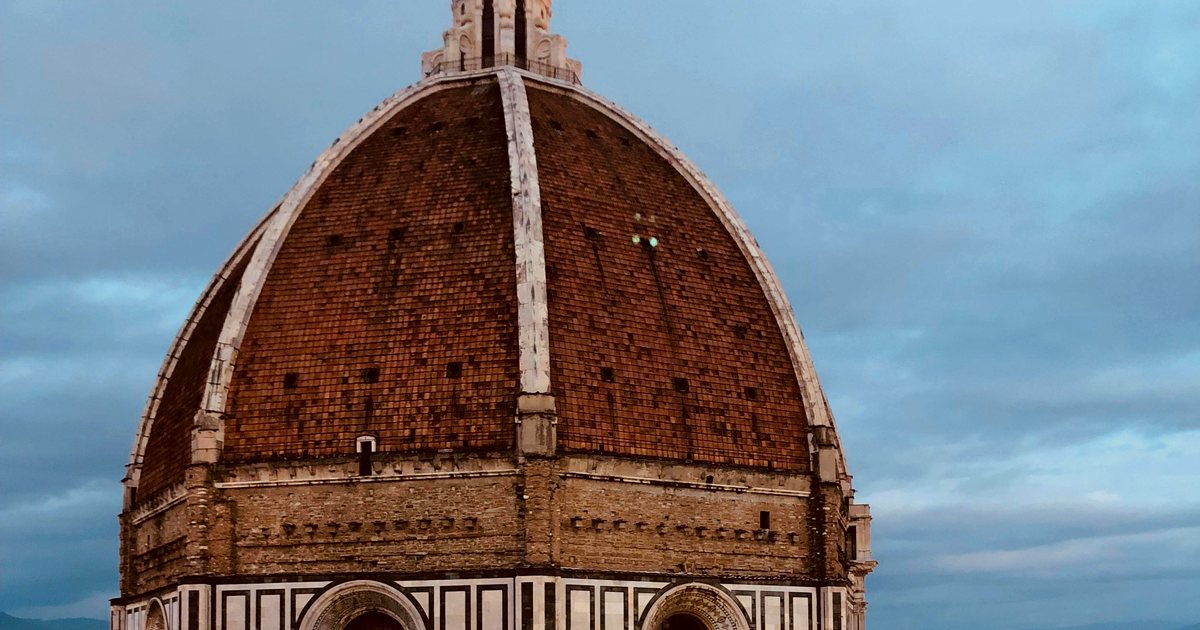
There are buildings that impress. And then there is the Florence Cathedral — the Cattedrale di Santa Maria del Fiore — which does something rarer: it astonishes, repeatedly, across centuries, and at every scale from the distant skyline to the interior detail a centimetre from your face. This is a complete guide to understanding it, visiting it properly, and leaving with more than photographs.
The Duomo complex is not a single building. It is four — the Cathedral itself, Brunelleschi’s Dome, Giotto’s Campanile, and the Baptistery of San Giovanni — arranged around one of the most concentrated accumulations of artistic and architectural genius in the world. To visit any one without understanding the others is to miss the point entirely. This guide covers all of them, in depth.
Coffee by The Dumo-Florence Cathedral formally the Cattedrale di Santa Maria del Fiore in Florence, Italy pic.twitter.com/CU6PhvEouG
— Linda Fritz (@LindFritz) November 19, 2021
|
1296
year construction began
|
140 yrs
to complete the dome
|
463
steps to the dome lantern
|
4,000+
daily visitors in peak season
|
In 1296, the city of Florence made a decision of almost reckless ambition: to build a cathedral that would surpass every other Christian church in the world. The commission went to Arnolfo di Cambio, who designed a nave of extraordinary width — so wide, in fact, that no one had any idea how the dome at its eastern end would ever be constructed. The problem was left, quite literally, for future generations to solve.
It took nearly a century and a half. The nave and walls were complete by the late 14th century; the drum on which the dome would sit was finished by 1420. But the dome itself — spanning 42 metres, at a height where conventional timber centring was impossible — remained an open hole in the Florentine skyline, a monument to the gap between ambition and engineering knowledge.
The solution came from Filippo Brunelleschi, a goldsmith and clockmaker with no formal architectural training, who studied Roman buildings — particularly the Pantheon — and devised a double-shell construction method that required no supporting scaffolding from below. He invented new machines to lift materials, new brickwork patterns to distribute weight, and a construction management system sophisticated enough to coordinate hundreds of workers on a structure of unprecedented complexity. The dome was completed in 1436 — the largest masonry dome ever built, a record it still holds nearly six centuries later.
| Year | Event | Architect / figure |
|---|---|---|
| 1296 | Foundation stone laid; new cathedral commissioned | Arnolfo di Cambio |
| 1334 | Campanile construction begins | Giotto di Bondone |
| 1359 | Campanile completed | Francesco Talenti |
| 1418 | Competition announced to design the dome | Opera del Duomo |
| 1420 | Dome construction begins — Brunelleschi’s revolutionary method | Filippo Brunelleschi |
| 1436 | Dome completed and consecrated by Pope Eugene IV | Brunelleschi |
| 1461 | Lantern at dome’s summit completed | Michelozzo |
| 1587–1688 | Original Gothic facade demolished; new marble facade designed | Emilio De Fabris |
| 1887 | Current neo-Gothic marble facade completed — the face Florence knows today | Emilio De Fabris |
The dome is not simply the most recognisable feature of the Florence skyline. It is one of the most consequential engineering achievements in human history — the point at which medieval building technique ended and something recognisably modern began. Understanding what Brunelleschi actually did transforms the experience of looking at it.
The core problem was this: the dome needed to span 42 metres at a height of 55 metres above the cathedral floor — far beyond the range of conventional wooden centring, which required temporary timber scaffolding from ground level to support the structure while the mortar dried. At that span and height, the timber alone would have cost more than the entire rest of the building.
Brunelleschi’s solution was a double shell: an inner structural dome and an outer decorative one, connected by a network of ribs and rings, with the bricks laid in a herringbone pattern (a spina di pesce) that locked each course into the ones below before the mortar set. The structure was essentially self-supporting as it rose — no centring required. He also designed the ox hoist, a reversible crane that could lift materials directly to the working platform and then lower them again without being dismantled, saving enormous time and cost.
| Measurement | Figure | Context |
|---|---|---|
| Internal diameter | 42.2 metres | Larger than the Pantheon in Rome (43.3m), but at vastly greater height |
| Height to lantern | 114.5 metres | Tallest structure in Florence. Visible from 60km away in clear conditions |
| Weight | ~37,000 tonnes | Approximately 4 million bricks used in construction |
| Steps to the lantern | 463 | Climb passes between the inner and outer shells — unique architectural experience |
| Construction time | 16 years (1420–1436) | At peak: ~300 workers per day on the structure |
| Interior fresco | 3,600 m² | Last Judgment by Giorgio Vasari and Federico Zuccari, 1572–1579 |
The climb to the lantern is one of the great architectural experiences available anywhere in the world — and one that most visitors do not fully appreciate before they begin. The 463 steps are not a simple staircase. The route passes through the space between the inner and outer shells of the dome itself: narrow, occasionally vertiginous passages where you can see Brunelleschi’s brick herringbone work at arm’s length and look through small windows directly into the cathedral below.
About two-thirds of the way up, the route opens onto the interior gallery that runs around the base of the lantern — a circular walkway where you look down 55 metres to the cathedral floor and directly into the Vasari frescoes of the Last Judgment at a distance of a few metres. This is a genuinely extraordinary moment. The final section then continues up and out onto the exterior lantern gallery, with a 360-degree panoramic view of Florence, the Chianti hills, and on a clear day the beginning of the Apennines.
The interior of Santa Maria del Fiore surprises visitors who expect the decorative richness of later Italian churches. It is austere — deliberately so. The Florentines valued the structural clarity of the Gothic interior and did not overlay it with the Baroque decoration that filled so many other cathedrals in the 17th and 18th centuries. The result is a space of extraordinary scale — the nave is 153 metres long — that reads clearly and powerfully as architecture.
| Work / Feature | Location | Why it matters |
|---|---|---|
| Last Judgment fresco | Interior of the dome | 3,600 m² by Vasari and Zuccari. Best viewed from the dome climb gallery at close range |
| Paolo Uccello’s clock face | Above the main entrance (west wall) | One of the oldest surviving liturgical clocks in the world. Runs anti-clockwise in the medieval tradition |
| Equestrian fresco of Sir John Hawkwood | North aisle (left wall) | By Paolo Uccello (1436). A trompe-l’oeil painted to resemble sculpture — one of the earliest perspective experiments in Western art |
| Equestrian fresco of Niccolò da Tolentino | North aisle, beside Hawkwood | By Andrea del Castagno (1456). A companion piece — comparing the two reveals twenty years of progress in perspective and naturalism |
| Dante and the Divine Comedy | South aisle (right wall) | Fresco by Domenico di Michelino (1465). Dante holds the Commedia, with the three realms behind him and Florence to his right |
| Brunelleschi’s tomb | Crypt beneath the cathedral | One of only two burials ever permitted inside the cathedral. The honour reflects the magnitude of what he achieved |
| Gnomon and sundial | South transept floor | A precision astronomical instrument installed by Paolo dal Pozzo Toscanelli in 1475. Used to determine the exact date of the summer solstice |
Giotto di Bondone — primarily known as a painter, the man who arguably invented Western naturalistic art — was appointed master of works for Florence Cathedral in 1334, aged around 67. He spent the last three years of his life designing and beginning the bell tower that still bears his name, a 84-metre structure in white, green, and pink Tuscan marble that stands as one of the finest examples of Gothic decorative architecture in Italy.
Giotto died in 1337 having completed only the first level. The tower was continued by Andrea Pisano and completed by Francesco Talenti in 1359. Its defining feature — and the reason a climb of its 414 steps rewards the effort independently of the dome — is the sculptural programme on the lower registers: hexagonal and diamond-shaped reliefs depicting the Arts and Sciences, the Planets, the Virtues, the Sacraments, and the Liberal Arts. The originals (by Pisano and Luca della Robbia) are in the Museo dell’Opera del Duomo; the reliefs on the tower today are casts, but accurate ones.
From the top of the Campanile — 414 steps, rather than 463 — the view across to the dome is the best available: you see Brunelleschi’s structure from the side, at close range, at eye level with the drum. It is the view that reveals the dome’s engineering most clearly and is, for many visitors, more memorable than the view from the dome itself.
The octagonal Baptistery that stands directly opposite the Cathedral’s west facade is the oldest building in the Piazza del Duomo — possibly the oldest in Florence. Its exact origin is debated: most scholars now date the current structure to the 11th or 12th century, though it incorporates Roman masonry and may stand on the site of a Roman building or an earlier church. Dante was baptised here. So, almost certainly, were Brunelleschi and Giotto.
The interior contains one of the greatest medieval mosaic programmes in Italy — a Byzantine-influenced ceiling covering 1,000 square metres, depicting the Last Judgment, the life of Christ, the life of John the Baptist, and scenes from Genesis. The Christ in Majesty at the apex, eight metres tall, is the image that greets you as your eyes adjust to the interior: an image of authority and presence that the Florentines of the 13th century would have experienced as a direct visual encounter with divine power.
But the Baptistery’s most famous feature faces outward: the three sets of bronze doors. The south doors by Andrea Pisano (1336) were the first commission. The north doors by Lorenzo Ghiberti (1403–1424) won a competition that launched the Renaissance — the original models, submitted by Ghiberti and Brunelleschi, survive and are displayed in the Bargello. Ghiberti’s east doors (1425–1452) were called by Michelangelo the Gates of Paradise — a name that has stuck. The originals are in the Museo dell’Opera del Duomo; the doors on the Baptistery today are casts.
| Doors | Artist | Date | Subject | Significance |
|---|---|---|---|---|
| South doors | Andrea Pisano | 1330–1336 | Life of John the Baptist; Virtues | First bronze doors on the building; Gothic elegance |
| North doors | Lorenzo Ghiberti | 1403–1424 | Life of Christ; Evangelists; Fathers of the Church | Won landmark 1401 competition; launch of Renaissance sculpture |
| East doors (Gates of Paradise) | Lorenzo Ghiberti | 1425–1452 | Old Testament scenes in 10 large panels | Called „Gates of Paradise“ by Michelangelo. Originals in Museo dell’Opera |
The museum directly behind the Cathedral is, by a significant margin, the most undervisited major art institution in Florence. This is partly because its entrance is on a side street and partly because it lacks the name recognition of the Uffizi or the Accademia. It is a serious error of omission. The Museo dell’Opera houses the originals of almost everything removed from the Duomo complex for conservation over the past century: the Gates of Paradise, Donatello’s Mary Magdalene, Luca della Robbia’s Cantoria, the original panels from the Campanile, Brunelleschi’s death mask, and — the reason alone to visit — Michelangelo’s Pietà Bandini.
The Pietà Bandini (c. 1547–1555) is one of Michelangelo’s last works, begun when he was in his seventies and intended for his own tomb. He attacked the marble with a hammer in frustration at a flaw in the stone, and a pupil partially repaired it. The result — Christ’s broken body supported by Nicodemus (whose face, scholars agree, is a self-portrait of Michelangelo at the end of his life) — is among the most psychologically charged works in Western art. It stands in a room by itself, at eye level, in a space designed by the architect Richard Goy, lit as if it were still emerging from the stone.
| Work | Artist | Why it matters |
|---|---|---|
| Pietà Bandini | Michelangelo (c.1547–55) | Michelangelo’s self-portrait as Nicodemus. Intended for his own tomb. One of the most moving works in Florence |
| Gates of Paradise (originals) | Lorenzo Ghiberti (1425–52) | Ten gilded bronze panels depicting the Old Testament. Named by Michelangelo. Seen up close, the depth and narrative complexity are extraordinary |
| Cantoria (Singing Gallery) | Luca della Robbia (1431–38) | Ten marble reliefs of children singing and playing instruments. One of the most joyful works of the early Renaissance |
| Mary Magdalene | Donatello (c.1453–55) | Polychromed wood. A penitent figure of devastating psychological realism — as far from conventional beauty as sculpture can go |
| Brunelleschi’s death mask & models | Various | Models of the dome construction machinery, Brunelleschi’s brick samples, competition panels — the archaeology of the dome’s engineering |
| Venue | Included | Booking required | Time needed |
|---|---|---|---|
| Cathedral (Santa Maria del Fiore) | Yes | Timed entry slot | 45–90 min |
| Brunelleschi’s Dome (climb) | Yes | Specific timed slot — book early | 1.5 – 2 hrs |
| Giotto’s Campanile (climb) | Yes | Queued entry (less crowded than dome) | 1 – 1.5 hrs |
| Baptistery of San Giovanni | Yes | Timed entry slot | 30–45 min |
| Museo dell’Opera del Duomo | Yes | No booking needed; rarely crowded | 1.5 – 2.5 hrs |
| Santa Reparata Crypt | Yes | Accessed from inside the Cathedral | 30 min |
|
Book the dome first
Dome timed slots sell out days — sometimes weeks — ahead in high season. Book at operaduomo.firenze.it the moment your dates are confirmed. Everything else can be managed around this slot.
|
Start at the museum
Visit the Museo dell’Opera first. Understanding what you are about to see — the dome’s engineering, the original doors, Brunelleschi’s models — transforms the experience of the complex itself. Allow 90 minutes minimum.
|
|
Early morning or evening
The Piazza del Duomo at 7:30 AM — before the tour groups arrive — is a completely different place. The marble catches the early light differently. The proportions read more clearly without crowds. Try to experience it at this hour even if your booked visits are later.
|
Climb both towers
The dome and the Campanile offer genuinely different experiences. From the Campanile top you see the dome’s engineering most clearly; from the dome top you see the city and the hills. Both are worth the effort — plan for a full morning or afternoon for the complex.
|
The Piazza del Duomo sits at the heart of Florence’s historic centre, within five minutes‘ walk of most of the city’s other major institutions. After the complex, the natural progression is south towards the Piazza della Signoria and the Uffizi — or east towards Santa Croce, where Dante, Michelangelo, Galileo, and Machiavelli are buried within a few metres of each other.
For lunch or an afternoon aperitivo, the streets immediately around the Duomo are predictably tourist-heavy. Walk three minutes north to the area around San Lorenzo, or cross the Arno into the Oltrarno, where the restaurants serve a genuinely local clientele and the wine lists draw on Chianti and Morellino rather than markup-inflated Chianti for tourists. For a full guide to Florence’s wine scene — from the enotece closest to the Duomo to private Chianti estate visits — see our Florence and Wine guide.
And if the city itself begins to feel like more than a temporary proposition — if the quality of light, the scale of the streets, and the depth of cultural life start to feel like home rather than holiday — our guide to Florence real estate, neighbourhoods, and the Italian Flat Tax covers what buying property here actually involves in 2026.
The Florentine Cathedral is not a relic. It is a living argument — about what human ambition, at its highest and most sustained, can achieve. The people who began it in 1296 knew they would never see it finished. The people who designed the dome in 1418 had no certainty it would stand. The painters who covered its interior in the 1570s were working in a space that had been open to the sky a century before.
What emerged, across nearly two centuries of collective effort, is a structure that remains — despite everything — the defining image of a city, the benchmark against which every other dome in the world is measured, and the most eloquent physical expression of what the Renaissance believed about the relationship between human intelligence and divine possibility. No photograph prepares you for it. No description quite does the job.
Brunelleschi solved a problem that had defeated European architecture for a century. He did it without computers, without steel, without structural engineering as a discipline. He did it with geometry, observation, and the willingness to build what others said could not be built. The dome is still there.
Brunelleschi dome
Cattedrale di Santa Maria del Fiore
Giotto Campanile
Gates of Paradise Florence
Baptistery San Giovanni
Museo dell’Opera del Duomo
Michelangelo Pietà Bandini
Florence travel guide 2026
climbing the dome Florence
Florence cathedral history
0 Kommentare zu „Inside the Florence Duomo: History, Art & Everything You Need to Know Before You Visit“