hePuglia is the part of Italy that the rest of Italy talks about when it thinks nobody is listening. It is the region that Italians have always known about and the rest of Europe is only now discovering – which means, depending on when you go and where you stay, you can still find the version of southern Italy that has largely disappeared everywhere else: unhurried, deeply local, and entirely itself.
Puglia Italy: From Gargano to Santa Maria di Leuca
Stretching from the spur of the Gargano promontory in the north to the very tip of the heel at Santa Maria di Leuca in the south, Puglia is one of Italy’s largest regions and one of its most varied. The landscape shifts dramatically as you move through it: limestone plateaus and olive groves inland, dramatic cliffs and clear Adriatic water on one coast, calmer Ionian shores on the other. If you want to discover other regions like the Lake Como, we also provide information about this area.
Puglia Italy: Food & Architecture
The food, the architecture, the light – all of it is specific to this place in a way that is increasingly hard to find in more visited parts of the country. For those who have already explored the obvious Italian itineraries, Puglia is often the destination that resets the relationship with the country entirely. For those who haven’t, it is an excellent place to start. Our review of Palazzo Daniele – one of Europe’s most celebrated boutique hotels, located at Puglia’s southern tip – goes into detail on what a stay in the deep south of the region looks and feels like.
Why Puglia Now
Puglia has been written about as a rising destination for at least a decade. What is actually true in 2026 is more nuanced. Also, the north of the region – the Valle d’Itria, Alberobello, Ostuni, Polignano a Mare – has become genuinely popular, particularly in July and August when Italian domestic tourism fills coastal towns to capacity. The south, however – the Salento peninsula, the area around Lecce, the villages around Gagliano del Capo and Otranto – remains significantly quieter, and the quality of what you find there is exceptional.
The advice that applies across the region: come in May, June, or September. This light is extraordinary, the temperatures are warm but manageable, the beaches are not crowded, and restaurants have time for you. July and August are viable but busy, particularly on the coast. The interior is always calmer than the sea.
Where to Go – The Essential Towns and Areas
Lecce
The baroque capital of Salento – often called the Florence of the South. Intricate stone carvings on every façade, excellent restaurants, a genuinely liveable city energy. More beautiful after dark than during the day.
Best for
Architecture, food, nightlife, culture
Alberobello
UNESCO World Heritage Site – the trulli, cone-shaped limestone houses built without mortar, create a genuinely extraordinary landscape. Worth visiting early morning or late evening to avoid peak crowds.
Best for
Architecture, photography, day trips
Ostuni
The White City – a hilltop town of whitewashed buildings above olive groves that stretch to the sea. Strong restaurant and bar scene, beautiful old town, well-located for coast and interior.
Best for
Base camp, food, views, sunsets
Polignano a Mare
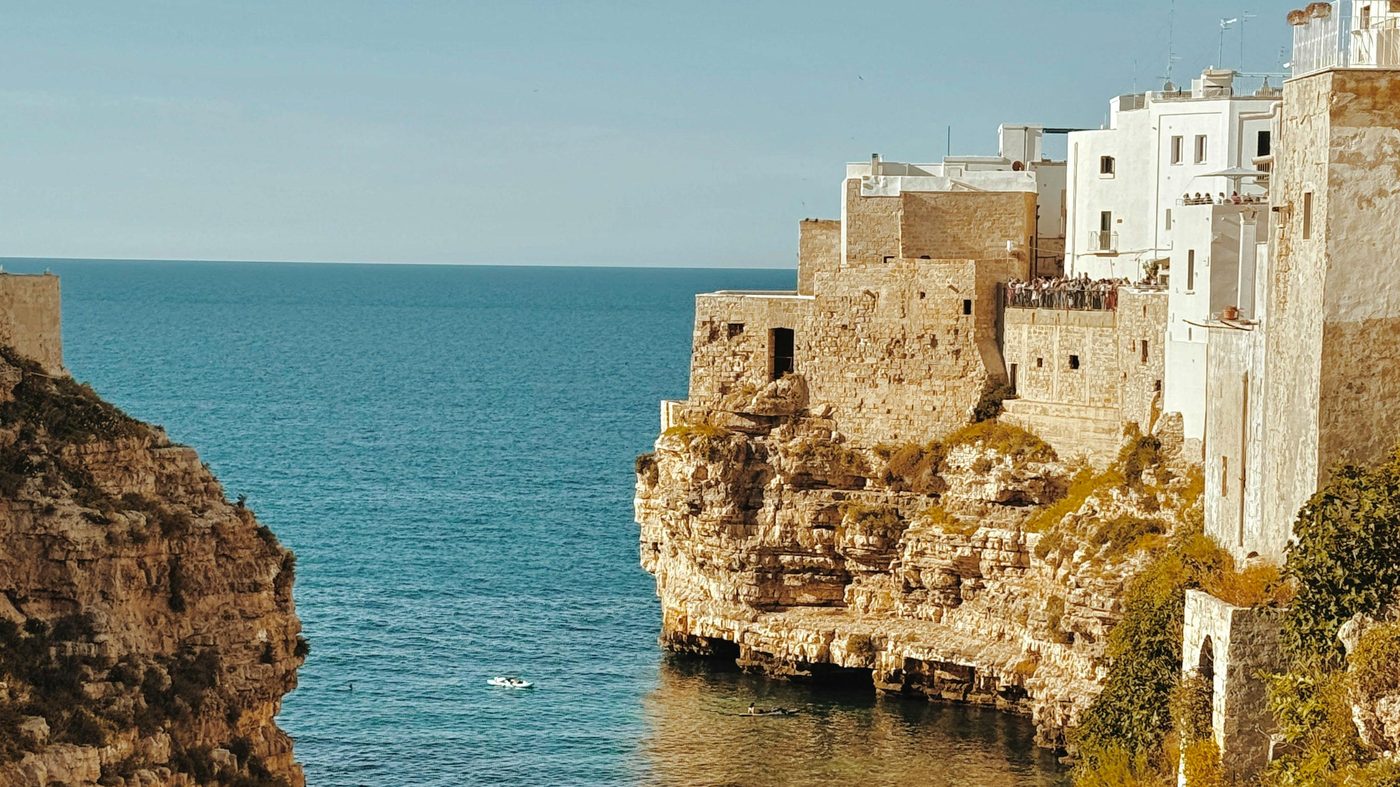
A coastal town built on limestone cliffs above the Adriatic, with the famous Lama Monachile beach wedged between rock faces. One of Puglia’s most photographed spots – go early to beat the crowds.
Best for
Coast, swimming, photography
Otranto
The easternmost city in Italy, with a Byzantine cathedral floor mosaic that is one of the country’s most extraordinary artworks. Clear turquoise water, a medieval castle, a genuinely intact old town.
Best for
History, swimming, eastern coast
Gagliano del Capo / Salento tip
The very end of Italy. Quiet, otherworldly, with spectacular coast on both sides of the peninsula. Home to Palazzo Daniele, one of Europe’s finest boutique hotels.
Best for
Slow travel, design hotels, coastline
Bari
The regional capital – a proper southern Italian city with an excellent old town, the Basilica di San Nicola, and grandmothers rolling orecchiette in doorways on Via dell’Arco Basso. A good entry point.
Best for
Food, culture, transport hub
Gargano / Tremiti Islands
The spur of the boot – the Gargano national park, dramatic coastline, the Foresta Umbra, and the Tremiti Islands offshore with crystal-clear water and excellent snorkelling.
Best for
Nature, hiking, islands
What to Do in Puglia
Eat Orecchiette in Bari
The pasta of Puglia is orecchiette – little ears of fresh pasta, made by hand, typically served with cime di rapa (turnip tops) and a good Puglian olive oil. In Bari’s old town, on Via dell’Arco Basso, women still make it by hand at small tables outside their houses and sell it to passers-by. Watching the process and buying a bag is one of the genuinely unrepeatable food experiences of Italy.
Visit the Trulli of Alberobello
A UNESCO World Heritage Site that feels straight out of a storybook, Alberobello’s cone-shaped trulli houses were built from white limestone without mortar, creating a one-of-a-kind skyline. The Rione Monti district has the highest concentration. Go at opening time or in the early evening to avoid the worst of the midday crowds.
Spend a Morning in Lecce
Often called the Florence of the South, Lecce is the cultural heart of Puglia. Every corner reveals another intricately carved church façade or grand old palazzo – it’s like walking through an open-air museum. The Piazza del Duomo is the place to start. The evening passeggiata along Via Trinchese is excellent.
Swim at Polignano a Mare
The beach at Lama Monachile, wedged between limestone cliffs that drop directly into the Adriatic, is one of the most dramatic swimming spots in southern Italy. The water is clear to the point of improbability. Go early – it fills quickly in summer.
Take a Cooking Class
Puglian food is among the most honest in Italy – olive oil, legumes, vegetables, bread, seafood. A cooking class with a local cook is one of the best ways to understand the culture of the place. Palazzo Daniele in Gagliano del Capo offers classes focused on Salentine tradition; similar experiences are available across the region.
Drive the Valle d’Itria
The inland valley between Alberobello, Locorotondo, Cisternino and Martina Franca is the most cinematically beautiful part of Puglia – ancient olive groves, limestone trulli scattered across rolling hills, whitewashed villages. A hire car is essential. The drive between Ostuni and Alberobello at golden hour is difficult to forget.
Taste Puglian Wine
Puglia is one of Italy’s most important wine regions. Primitivo – the same grape as California Zinfandel – and Negroamaro are the key reds; Verdeca and Fiano produce the best whites. The Salento peninsula has a strong natural wine scene. Cantina Due Palme, Gianfranco Fino and Leone de Castris are producers worth knowing. Several estates offer visits and tastings by appointment.
Where to Stay
Puglia has an excellent range of distinctive accommodation. The most characterful options are the masserie – fortified farmhouses, often with olive groves and pools, many of which have been restored as luxury hotels. Masseria Torre Coccaro near Fasano and Masseria Il Frantoio near Ostuni are among the most established. For a very different experience at the southern tip of the region, Palazzo Daniele in Gagliano del Capo – a restored aristocratic palazzo with eleven suites and one of the finest kitchens in Salento – represents the best of what Puglia’s boutique hotel scene has become.
Getting There and Getting Around
Puglia has two international airports: Bari in the north and Brindisi in the south. Low-cost carriers including Ryanair, EasyJet and Wizz Air operate direct flights from cities including London, Berlin, Paris and Barcelona. From elsewhere in Italy, high-speed trains connect Rome and Naples to Bari.
A hire car is not optional for anyone who wants to explore seriously. Public transport connects the major towns but not the coastline, the inland villages, or most of the places worth visiting. Driving in Puglia is straightforward by Italian standards, and the roads through the Valle d’Itria and the Salento are genuinely enjoyable. Parking in historic town centres can be challenging – most towns have paid parking just outside the old town walls.
When to Go
May, June and September are the ideal months. Temperatures are warm, the light is remarkable, and the region is populated but not crowded. July and August bring Italian domestic tourism in force – the coast is busy and accommodation prices rise significantly. The interior remains calmer year-round. October is increasingly popular and offers excellent value. The far south – Salento and Gagliano del Capo – is quieter than the north in all seasons.
For a different perspective on Italy’s great cities, our guide to Florence covers the Tuscan capital in depth – a natural counterpoint to the very different Italy you find in the south.
0 Kommentare zu „Puglia, Italy – Why the Heel of the Boot Is the Country’s Most Compelling Region“