
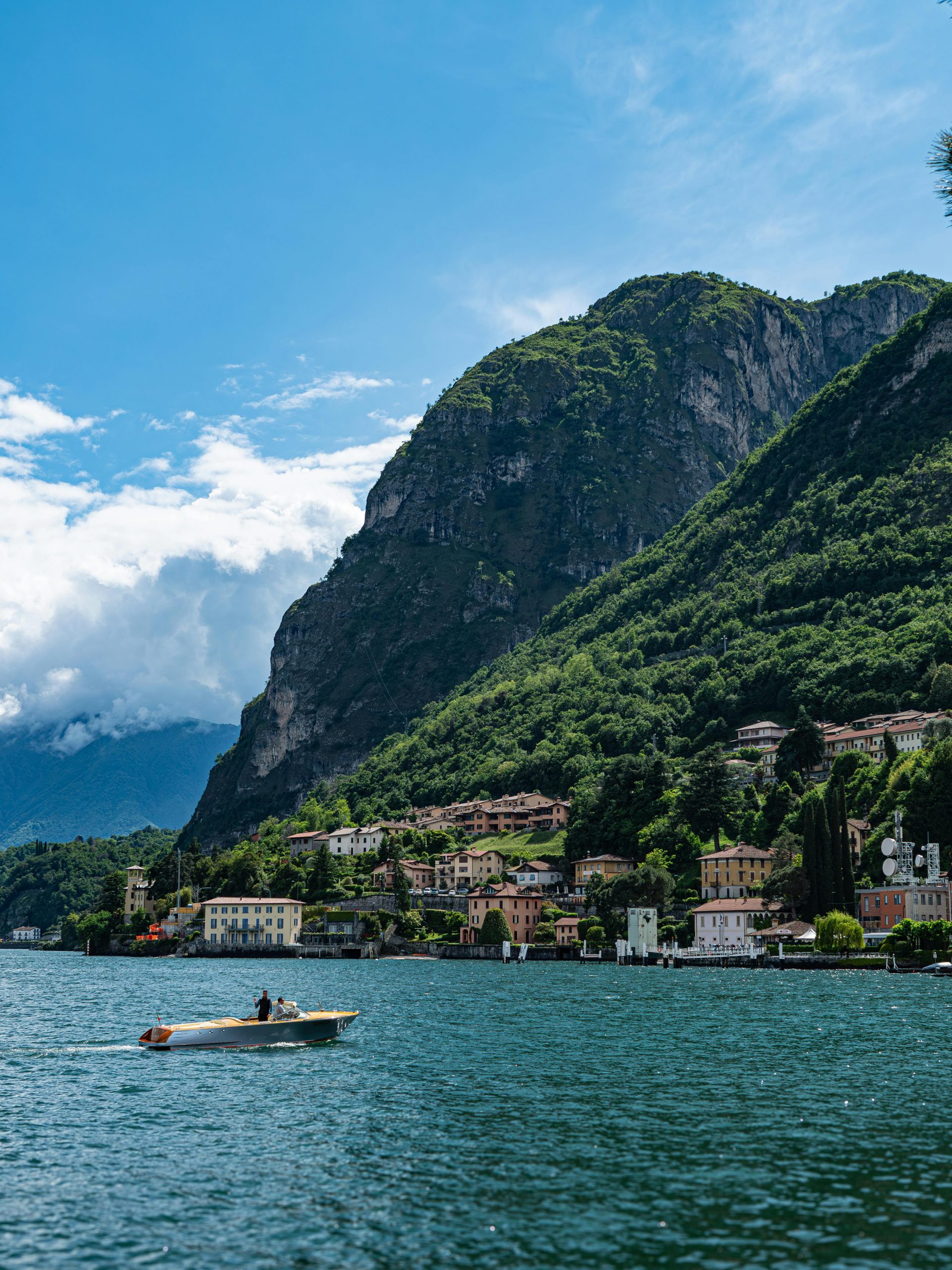
Lake Como is not simply a place to visit. For a growing number of buyers from Europe, the United States, and the Middle East, it is a place to own.
The appeal is clear: extraordinary natural beauty, a mild alpine climate, world-class restaurants, and a cultural depth that most Mediterranean destinations cannot match. However, the Lake Como real estate market is more nuanced than most international buyers expect.
In this guide, you will find everything you need before buying property on Lake Como in 2026. We cover which areas suit which buyer, what prices look like across the lake, which property types are available, and what pitfalls to avoid.
Lake Como Has Three Branches — and Three Separate Markets
The most important thing to understand about Lake Como real estate is this: there is no single market. There are three, shaped by the lake’s distinctive inverted-Y geography.
- The lake splits into three branches.
- The southwestern branch runs toward Como city.
- The southeastern branch runs toward Lecco.
- The northern branch opens toward Colico.
As a result, the character, the prices, and the buyer profile change entirely depending on where you look. In other words, buyers who treat the whole lake as one market almost always end up in the wrong place for their lifestyle or budget.

The Southwestern Branch: Sophisticated and Most Sought-After
The southwestern branch runs north from Como city through Cernobbio, Moltrasio, Laglio, Tremezzo, and Menaggio. This is what most people picture when they think of Lake Como. The grand historic villas sit here — Villa d’Este, Villa Carlotta, Villa Balbianello. The subtropical microclimate allows gardens to grow palms and citrus trees that feel entirely out of place at this altitude.
Furthermore, the towns along this branch are polished. The waterfront promenades are well maintained. The restaurants are excellent and ferry connections are frequent. As a result, this branch attracts the highest concentration of international buyers, the highest prices, and the strongest rental demand.
However, it is also the most competitive. Properties here move quickly. Off-market deals — which represent a large portion of high-value transactions — require a trusted local agent or existing community connections.
Key towns to consider:
- Cernobbio — prestige address, close to Como city, excellent infrastructure
- Laglio and Moltrasio — quieter and more residential, popular with long-stay buyers
- Tremezzo and Cadenabbia — central lake position, direct views of Bellagio, strong rental appeal
- Menaggio — the most liveable town on the lake, with schools, shops, golf, and tennis
Menaggio, Lake Como, Italy
— 𝕏 Travels, Hotels and Resorts (@em3dia) January 20, 2026
🎥italia_io_ti_amo I IG pic.twitter.com/Nd6sgNa6Y0
The Southeastern Branch: More Authentic and Better Value
The southeastern branch runs east from Como through Nesso and Lezzeno toward Lecco. It is a completely different world from the western shore. The mountains feel closer and the roads are narrower. Also, the towns are less polished and far less visited by tourists.
Nevertheless, this is not a disadvantage. For the right buyer, this is the most genuinely Italian part of the lake. Daily life carries on with little regard for tourism. Moreover, property prices here are 30 to 50 percent below comparable properties on the western shore.
Lecco itself is a proper city of 47,000 people. It offers excellent train connections to Milan and a real estate market that functions more like a regional Italian city than a resort. Prices are significantly lower than in Como city, and the quality of life for year-round residents is high.
Key towns to consider:
- Nesso — dramatic gorge, ancient stone village, extraordinary character
- Lezzeno — quieter than the western shore, strong local community
- Lecco city — full urban services, excellent value, ideal for year-round living
- Bellagio — at the junction of all three branches, the most famous village on the lake
The Northern Branch: Alpine, Spacious, and the Lake’s Best-Kept Secret
The northern branch runs from the central junction through Dongo and Gravedona up to Colico. It is the least known and the most dramatically alpine part of the lake. The basin widens here and the Alps become fully visible.
In addition, this branch attracts serious sailors, kiteboarders, and windsurfers. The reliable afternoon wind that channels down from the Alps is an asset here, not a nuisance. It also attracts buyers who want more space for their money and a slower, more local pace of life.
Property prices in the north are the lowest on the lake — often less than half the cost of equivalent properties on the western shore. The tradeoff is infrastructure. Restaurants, shops, and transport connections are less developed. For buyers seeking a private retreat rather than an investment property, however, the north is worth serious consideration.
Key towns to consider:
- Gravedona ed Uniti — the main town of the north, with a commercial center and good lake access
- Dongo — historic significance, handsome lakefront, growing slowly
- Colico — at the northern tip, excellent for watersports, very reasonable prices
Lake Como Property Prices in 2026: What You Actually Pay
Lake Como property prices have risen substantially over the past decade. Strong international demand, limited supply, and the lake’s growing reputation as an alternative to the French Riviera have all pushed values up. That said, the market is not homogeneous. The price gap between the most and least expensive areas is significant.
Western Shore: Premium Prices, Premium Demand
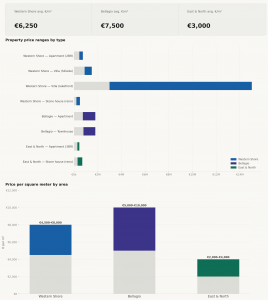
On the western shore — Cernobbio, Laglio, Tremezzo, and Menaggio — lake-view apartments typically range from €4,500 to €8,000 per square meter. A two-bedroom apartment of 80–100 square meters with a proper lake view will generally cost between €450,000 and €750,000.
Detached villas occupy a wider range. A modest hillside villa of 200–300 square meters with partial lake views starts from around €900,000. A historic lakefront villa with a private dock and direct water access, on the other hand, will typically start at €3 million and reach €15 million or beyond.
In addition, rustic stone houses needing renovation offer interesting opportunities. These former fishing houses and terraced hillside homes start from €200,000 to €500,000 in shell condition. Renovation costs in the Lake Como area typically run €1,500 to €3,000 per square meter for quality work.
Bellagio: The Most Famous Address on the Lake
Bellagio sits at the tip of the peninsula where all three branches meet. It offers the most dramatic views of any village on the lake. However, supply here is extremely limited. The historic village is compact, building constraints are strict, and very few properties come to market each year.
As a result, prices reflect this scarcity. Apartments within the historic center start at around €5,000 per square meter and reach €10,000 or more for exceptional properties. A restored stone townhouse of 150–200 square meters will typically cost between €800,000 and €1.8 million. Lakefront access in Bellagio is extraordinarily rare. When such properties appear, they are usually sold through private networks before reaching any public listing.
Eastern Shore and Northern Lake: Where Value Still Exists
On the southeastern branch and in the northern lake, prices drop significantly. Lake-view apartments in towns like Nesso, Lezzeno, or Gravedona start from €2,000 to €4,000 per square meter. For example, a three-bedroom apartment of 120 square meters with genuine lake views might cost €280,000 to €450,000 — less than half the equivalent price on the western shore.
Furthermore, stone houses on the eastern shore offer some of the best renovation opportunities on the lake. Properties with ancient stone construction, terraced gardens, and private boat access can be found for €300,000 to €700,000 — budgets that simply do not exist on the western shore for comparable character.
Types of Lake Como Property: What the Market Actually Offers
Historic Lakefront Villas
The grand historic villa is the iconic Lake Como property. Think 18th or 19th century construction, formal gardens stepping down to a private dock, frescoed interiors, and views painted by artists for centuries. These properties come to market occasionally and represent the pinnacle of what the lake offers.
However, they also come with significant responsibilities. Historic villas are typically subject to vincolo — heritage protection orders that restrict changes to the exterior, the gardens, and often the interior too. Maintenance costs are substantial. Heating bills in winter are considerable.
For buyers with the budget and the patience, a historic lakefront villa on Lake Como is one of the most extraordinary private properties in Europe. For buyers who underestimate the ongoing commitment, it can become a beautiful burden.
Modern Luxury Apartments and Branded Residences
The Lake Como market has seen growing interest in high-quality new-build and recently renovated apartments, particularly in Como city and Cernobbio. These properties offer a very different proposition from the historic villas: low maintenance, modern systems, and guaranteed build quality.
Como city has seen several significant residential conversions in recent years. Historic buildings have been transformed into luxury apartments with underground parking, concierge services, and high-specification interiors. For buyers who want the Lake Como address without the complexity of a historic villa, these developments offer a compelling middle ground.
The branded residence concept has not yet fully arrived on Lake Como in the way it has in Monaco or the French Alps. Nevertheless, several projects combining hotel management with private ownership are in early development. Buyers interested in this category should watch the market closely over the next two to three years.
Stone Village Houses and Renovation Projects
The most characterful properties on Lake Como are the historic stone houses in smaller villages. These include former fishermen’s houses, terraced hillside homes, and ancient agricultural buildings. Many occupy positions that would command extraordinary prices if they were already finished.
These properties require patience, a good local architect, and a realistic renovation budget. Italian building regulations and heritage rules add complexity. Renovation timelines of two to four years are common for significant projects.
In return, however, buyers get a property of genuine character. It is built from local stone, shaped to fit a specific hillside or shoreline. No new-build development can replicate this quality of light or this connection to the lake.
Investment Properties and Short-Term Rentals
Lake Como is one of Italy’s strongest short-term rental markets. High-spending international visitors prefer villas and apartments to hotels, and supply of quality rental properties is limited. Weekly rental rates on the western shore range from €3,000 to €8,000 for well-positioned apartments and from €8,000 to €30,000 and above for larger villas with private pools.
The high season runs from May through September. July and August command the premium rates. That said, shoulder season — April, October, and increasingly March and November — has grown significantly as the lake attracts more year-round visitors.
Gross rental yields on quality properties typically run between 3 and 5 percent annually. However, management costs, platform fees, cleaning, and seasonal maintenance all need to be factored in. Properties in the most desirable positions — waterfront, with private dock access, or near Bellagio’s center — consistently outperform the market average.
Lake Como, Italy 🇮🇹 pic.twitter.com/6VXWnSQ0e0
— Travel Bucket List (@TravelBucketX) April 11, 2026
Buying Property in Italy as a Foreign National: What to Know
The Buying Process Has Two Key Stages
Italy’s property purchase process works in two stages. First comes the compromesso — the preliminary contract. Then comes the rogito — the final deed of sale. Both are signed before a notary. However, the Italian notary is a public official, not a legal representative of either party. Their role is to verify the legality of the transaction. They do not advocate for the buyer.
Therefore, foreign buyers should engage their own independent lawyer before signing any documents. At the compromesso stage, a deposit of 10 to 30 percent is paid. If the buyer withdraws without legal cause, this deposit is forfeited. If the seller withdraws, they must return double the deposit. For this reason, all due diligence must be completed before reaching this stage.
Taxes and Total Purchase Costs
Total purchase costs for a foreign buyer acquiring a Lake Como property as a second home typically amount to 9 to 12 percent on top of the agreed price. This includes registration tax of 9 percent of the cadastral value, notary fees, agent commission of around 3 percent plus VAT per side, and legal fees.
In addition, Italy’s flat tax regime for new residents has attracted significant interest from high-net-worth international buyers. It caps personal income tax at a fixed annual sum for individuals who move their tax residence to Italy. Nevertheless, the rules and eligibility conditions should be assessed by a qualified Italian tax advisor before making any decisions.
Heritage and Planning Restrictions
Lake Como sits within a protected landscape. Many of its finest properties carry heritage protection orders under Italian law. These orders restrict changes to facades, gardens, roof lines, and structural elements. In some cases, even interior alterations require approval from the Soprintendenza, the national heritage authority.
This is not a reason to avoid these properties. Many of Italy’s most magnificent private homes are listed buildings. However, it is a reason to conduct thorough due diligence before purchase and to work with an architect who has specific Lake Como experience.
The Long-Term Investment Case for Lake Como Property
Lake Como property values have risen consistently over the past 20 years. The strongest appreciation has come from the western shore and Bellagio. Notably, the market did not experience the sharp corrections seen elsewhere in Italy after 2008. This is partly because the buyer base is predominantly international and cash-rich, and partly because supply is genuinely constrained.
The lake cannot expand. New construction in the lakeside villages is tightly controlled. The stock of quality historic properties is finite. As a result, these structural supply constraints — combined with rising global demand from buyers looking for alternatives to the French Riviera — support a positive long-term outlook for values.
Climate is also increasingly a factor. The lake’s alpine surroundings moderate summer temperatures. Cernobbio and Menaggio are cooler in August than Nice, Amalfi, or Palma de Mallorca. As Mediterranean summers become more extreme, this is drawing more buyers north. French, Spanish, and Balearic second-home buyers are already looking at Lake Como as an alternative.
Nevertheless, the risks are real. Italian bureaucracy adds cost and time to any property transaction or renovation. Currency exposure affects buyers outside the eurozone. The short-term rental market, while strong, is subject to evolving local regulation. These factors are worth weighing carefully before committing.
The beautiful Lago di Como ,and Mandarin Oriental by the lake. pic.twitter.com/EepJqbqgdp
— KK (@KK09865) May 15, 2026
Which Part of Lake Como Is Right for You?
The answer depends on what you want your life on the lake to look like. Here is a simple breakdown:
- You want prestige and strong rental returns: Choose the western shore between Cernobbio and Menaggio. Budget from €500,000 for a quality apartment to €3 million and above for a villa. Expect strong competition for the best properties.
- You want authentic Italian character and better value: Look at the southeastern branch or the smaller northern villages. Budget from €200,000 for a renovation project to €600,000 for a finished property in a good position.
- You want Bellagio specifically: Be prepared for the most competitive sub-market on the lake. Properties rarely appear publicly. Engage a local agent with genuine village connections and be ready to move quickly.
- You want space and alpine character: Consider the northern lake. Budget from €150,000 for renovation projects to €400,000 for a finished property with lake views. Infrastructure is less developed, but you gain a corner of one of Europe’s most beautiful lakes almost entirely to yourself.
Final Thoughts: Buying on Lake Como Is a Decision That Outlasts the Market
The buyers who thrive on Lake Como are the ones who buy for the right reasons. Not primarily as a financial move. Not because prices are rising. And not because they fell in love with the idea after one weekend in Bellagio.
Instead, they bought because they understood the lake. They researched the specific area they wanted. They took time to understand the buying process. And they had a clear picture of how they intended to use the property.
The financial case for Lake Como real estate is strong. However, it is secondary to the lifestyle case. There are very few places on earth where you can wake up to this light, swim in this water, eat this food, and sail to dinner across a lake that has been inspiring travelers for two thousand years.
If you are serious about buying on Lake Como, start now. Not because prices are about to surge — but because finding the right property here takes time, patience, and knowledge that only comes from truly understanding what you are looking for.
0 Kommentare zu „Lake Como real estate – Where is the best place?“