
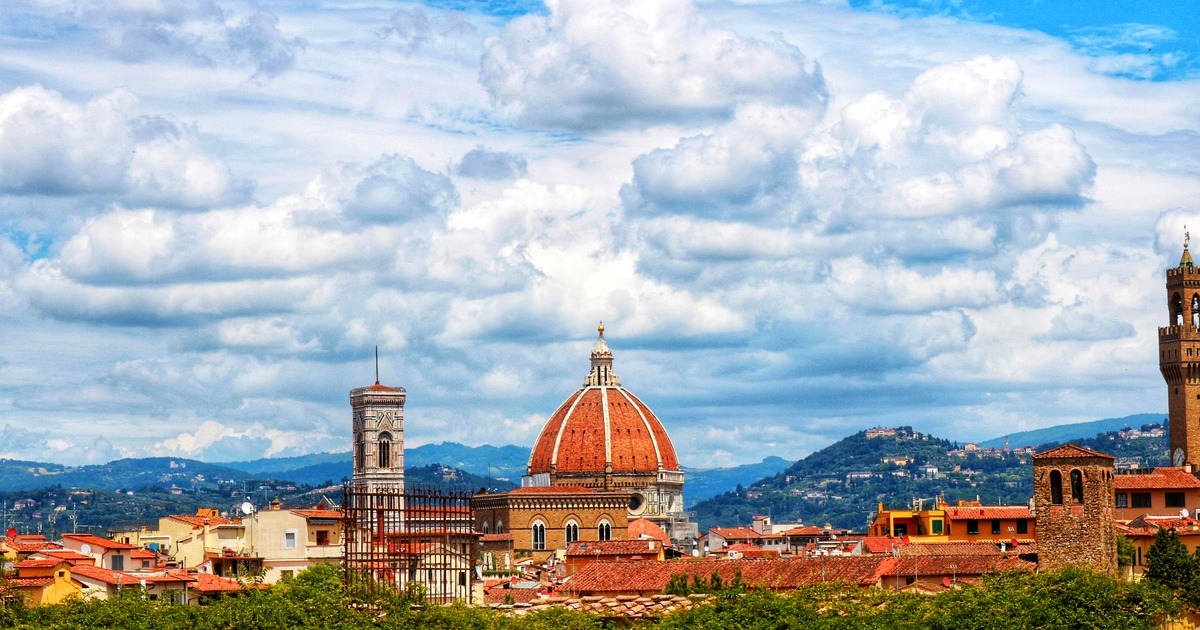
Florence does not reward rushing. It rewards the traveller who understands that this city operates on its own temporal logic — one measured not in tourist checklists, but in the quality of light at seven in the morning when the Piazza del Duomo is empty, in the silence of a museum before the crowds arrive, and in the particular satisfaction of a Negroni drunk slowly on a terrace above the roofline.
This is a day built around that logic. Not a highlight reel, but a curated sequence — of architecture, art, food, and stillness — designed for the traveller who wants to understand Florence rather than simply photograph it.
Quick Summary: A Perfect Day in Florence
The Day at a Glance
Morning: The Duomo Complex
The single most important piece of advice for Florence: arrive at the Piazza del Duomo at 07:30. Before the guided tours, before the selfie sticks, before the gelato vendors set up their carts. The marble catches the early light differently. The proportions of Brunelleschi’s dome — the largest masonry dome ever built, a record it has held for nearly six centuries — read with a clarity that midday crowds make impossible.
Brunelleschi solved a problem that had defeated European architecture for a century. He did it without computers, without steel, without structural engineering as a discipline — with geometry, observation, and the willingness to build what others said could not be built.
The Duomo complex is not one building — it is four: the Cathedral itself, Brunelleschi’s Dome, Giotto’s Campanile, and the Baptistery of San Giovanni. Visit them in the right order.
Start at the Museo dell’Opera del Duomo — almost no one does this, which is precisely why you should. Seeing Ghiberti’s original Gates of Paradise and Michelangelo’s Pietà Bandini before entering the complex transforms everything you see afterward. Allow 90 minutes. The museum is almost never crowded.
What to Visit and When
| Venue | What Not to Miss | Time | Book Ahead |
|---|---|---|---|
|
Museo dell’Opera
Start here
|
Pietà Bandini, original Gates of Paradise, Donatello’s Mary Magdalene | 90 min | Not needed |
|
Baptistery
San Giovanni
|
1,000 m² Byzantine mosaic ceiling; three sets of bronze doors | 30–45 min | Timed slot |
|
Brunelleschi’s Dome
463 steps
|
Space between inner and outer shells; Vasari frescoes up close; 360° panorama | 90–120 min | Book first |
|
Giotto’s Campanile
414 steps
|
Best view of the dome’s engineering — side-on, at eye level with the drum | 60–90 min | Less urgent |
Where to Have Coffee in Florence
Florence has strong opinions about coffee. The correct form is espresso or cappuccino, standing at the bar, consumed in under four minutes.
Where to Eat in Florence
Florence’s culinary identity is built on a paradox: a city that produces some of the world’s finest art tolerates only the simplest food. Bistecca Fiorentina, ribollita, pappardelle al cinghiale, crostini neri — the vocabulary is small and the standards are unforgiving.
| Restaurant | Best For | What to Order | Price |
|---|---|---|---|
|
Enoteca Pinchiorri
3 Michelin Stars
|
The finest table in Florence | Tasting menu; one of Italy’s great wine cellars; handmade pasta | €250–€400 pp |
|
Buca dell’Orafo
Near Ponte Vecchio
|
Classic Florentine trattoria | Ribollita, pappardelle al cinghiale, bistecca Fiorentina | €45–€75 pp |
|
Buca Mario
Since 1886
|
Florence’s oldest restaurant | Lampredotto, crostini neri, traditional Chianti Classico | €40–€65 pp |
|
Il Latini
Communal tables
|
Atmosphere, locals, no menu | Whatever the kitchen is making. Loud. Extraordinary. | €35–€55 pp |
|
Trattoria Sostanza
Since 1869
|
Florentine institution | Butter pasta, petti di pollo al burro. Small, no-frills. | €40–€60 pp |
Ordered by weight (minimum 600g), cooked on a wood fire, served rare, and finished with nothing but sea salt and Tuscan olive oil. If you ask for it well-done, the kitchen will decline. This is not rudeness — it is hospitality.
Afternoon: Uffizi Gallery & the Oltrarno
The Uffizi is the finest collection of Italian Renaissance painting in the world. It is also, in summer, one of the most crowded buildings in Europe. The solution is pre-booking — enter at a specific time, head directly to Botticelli’s rooms, and spend your two hours with intention rather than drift.
After the Uffizi, cross the Arno. The Ponte Vecchio is unavoidable and worth the crowds for thirty seconds. Proceed into the Oltrarno — the neighbourhood of artisans, wine bars, and restaurants that serve a genuinely local clientele. Walk uphill through Boboli toward Villa Cora’s gate on the Viale Machiavelli.
Where to Stay: Villa Cora
Villa Cora was built in 1865 for Baron Oppenheim on the Oltrarno hillside above Boboli. Its most famous resident was Empress Eugénie de Montijo — wife of Napoleon III — who chose it as her Florentine residence after the fall of the Second Empire. It is now, by a remarkable stroke of fortune, available by the night.
The frescoed ballrooms, gilded salons, and marble floors have been preserved rather than replicated. The pool terrace — with its panoramic view over the entire city, the Duomo on the horizon — is the finest elevated pool position in Florence.
Year built
Rooms & suites
Walk to Boboli
Per night from
Room Guide
| Room | From / Night | Standout Feature | Verdict |
|---|---|---|---|
|
Deluxe Room
|
~€650 | Period furnishings, high ceilings | Specify city view |
|
Superior Room
|
~€800 | Larger footprint, city or garden view | Good entry point |
|
Junior Suite
|
~€1,100 | Frescoed ceiling, separate sitting area | Recommended |
|
Suite
|
~€1,600 | Full living room, original architectural details | For longer stays |
|
Eugénie Suite
Named for the Empress
|
~€2,400+ | Panoramic views, original period decoration throughout | Book early |
The view of Florence from a city-facing room is the primary reason to stay at Villa Cora over any comparable property. The Terrace Bar at sunset — around 19:00, with a Negroni — is one of the finest places in the city. Reserve a table in advance in high season.
What to Book in Advance
| What | How Urgent | Notes |
|---|---|---|
|
Brunelleschi’s Dome
|
Essential | Book first, before anything else. Sells out weeks ahead in high season. operaduomo.firenze.it |
|
Uffizi Gallery
|
Essential | Always pre-book. Walk-up queue in July costs 90+ minutes. uffizi.it |
|
Enoteca Pinchiorri
|
Weeks ahead | Dinner fills up weeks in advance. Lunch is sometimes easier to secure short notice. |
|
Villa Cora Terrace Bar
|
Recommended | Reserve a table for 19:00. Especially important in May, June, and September. |
|
Vasari Corridor
|
Months ahead | Private guided tours only. Limited access, very high demand. |
|
Il Latini / Buca Mario
|
Not needed | Il Latini takes no reservations. Buca Mario accepts walk-ins most evenings. |
Final Thoughts
Florence does not need your approval. It has been the most beautiful city in the world for six hundred years and is entirely indifferent to the opinion of tourists. What it rewards — quietly, and only to those who pay attention — is genuine curiosity.
The dome that defeated European architecture for a century. The Gates of Paradise that Michelangelo named. The villa where an Empress chose to live in exile. The light on the Arno at dusk, unchanged since Brunelleschi looked at it in 1420.
That is exactly what makes it worth doing properly.
0 Kommentare zu „How to Spend A Perfect Day in Florence“